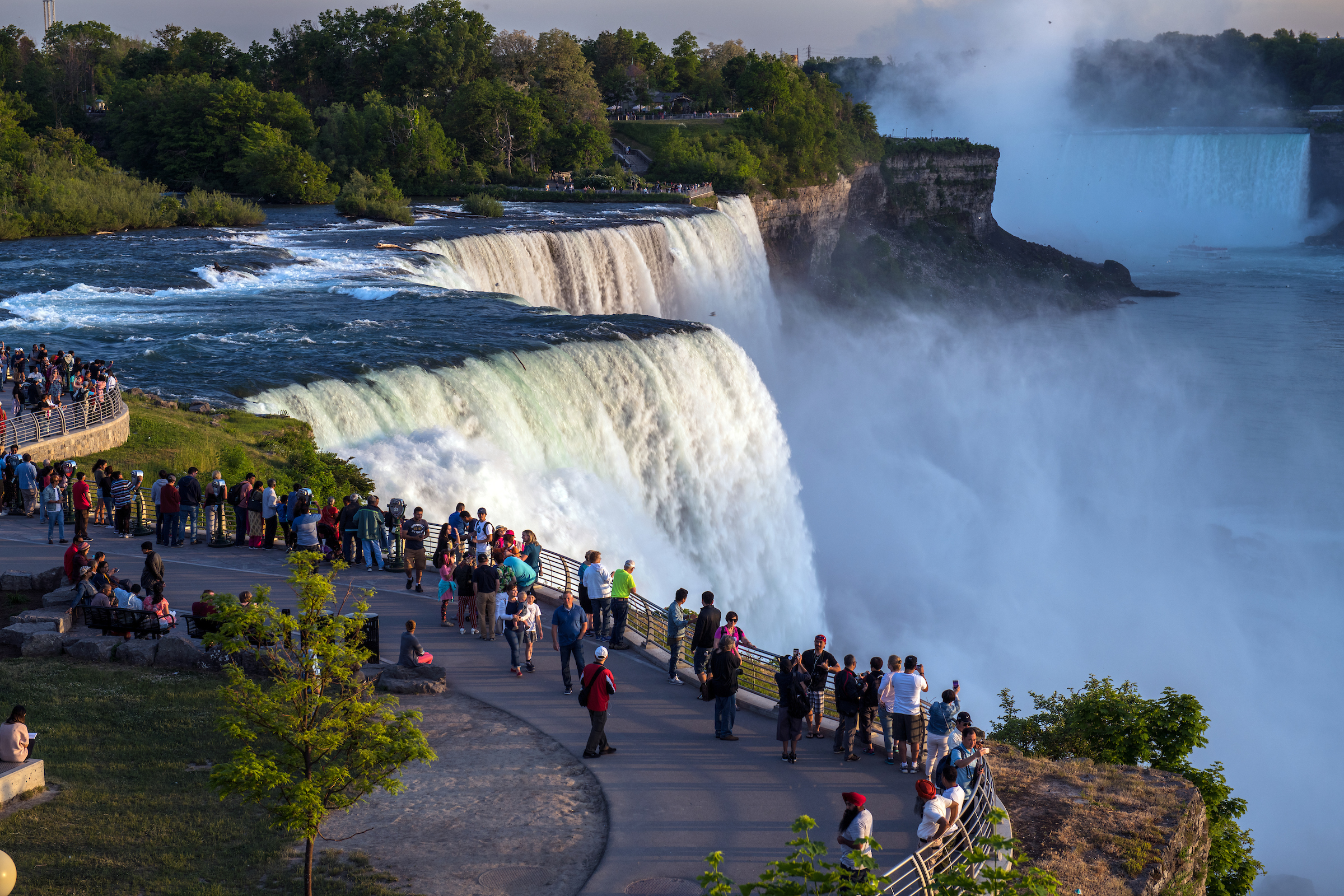
In Niagara Falls, home of big government the rich get richer while the poor get poorer

Bad luck comes in threes, they say, and for residents of Niagara Falls this cliché has been visited with a vengeance. The perennially cash strapped city has both the highest crime rate and the highest taxes per capita of any municipality in New York State, and is run by a disproportionately large number of administrators who make more than $100,000 annually.
The city boasts one of the best known tourist attractions on the face of the earth, the majestic falls themselves, and is the site of the Seneca Niagara Casino which, until recently, has contributed an average of $20 million a year into the city’s coffers.
Yet the living conditions of those who call the city home can best be described as bleak. Per capita income and median household income are well below statewide averages, even when those public employees earning six figures are figured into the equation.
Six out of every 10 residents are receiving some form of public assistance, and the latest “growth industry” to sweep the city consists of a pair of oversized methadone maintenance clinics to service the growing population of heroin addicts.
And with 158 registered sex offenders living there, chances are one in 315 that the guy ahead of you in line at Tops Friendly Market has been tried and convicted of some unspeakable crime.
The voting public hardly seems dissatisfied. In November, they returned two-term incumbent Mayor Paul Dyster to office in a three way race against local businessman John Accardo and city Water Board employee Glenn Choolokian. While he only managed to collect 47 percent of the vote, the 4,428 ballots cast in favor of his reelection were more than enough to ensure victory.
Many of those voting for Dyster –if not the majority – were employees of the city and the school district and their family members. The incumbent mayor enjoyed the support of both the police and fire unions as well as the teacher’s union.
Additionally, the voters elected school teacher Ezra Scott Jr. to the city Council, giving school district employees a solid, pro-Dyster majority. The ramifications of this have yet to become clear, but the traditional line dividing the city’s two main taxing entities has definitely been blurred.
With eight million visitors each year, coming from all around the globe, the condition and fate of Niagara Falls is more than just a local issue. For many of the tourists, the city is the only part of New York State they’ll ever visit. For others, it is the only destination in the entire country.
Despite the fact that city police officers constitute the majority of the 69 city employees who make more than $100,000 a year, Niagara Falls is a hotbed of street crime. Increasingly, tourists and locals alike are likely to become the victims of violent or property crime.
Niagara Falls has been named the most dangerous city in the state of New York by the popular internet site MyLife.com, while a detailed study conducted by the website Neighborhoodscout.com arrives at the conclusion that the city is the 53rd most dangerous place in the entire country.
Yet another website, Roadsnacks.net, reaches a similar conclusion.
“Niagara Falls has the 4th highest violent crime ranking in the entire state of New York, and the property crime rate ranks 2nd worst in the state,” the website reports. “In fact, in 2013, there were 2,807 property crimes committed. That’s a lot of stolen property.”
For a poor city unable to afford the kind of police and fire protection enjoyed by residents of other municipalities, this might be understandable. But that is not the case.
With 49,468 residents as of the 2013 US census estimate, the 69 employees earning more than $100,000 annually averages out to one big earner for every 717 residents. That is high compared to many other cities, large and small.
Binghamton, with 47,376 residents, has only seven $100,000 plus city employees, one out of every 6,768 residents. Troy, with 50,129 residents, has 34 city workers making more than $100,000, or one for every 1,474 citizens.
And Utica, with a population of 62,235, has only 19 earning more than $100,000. That’s one city worker earning more than $100,000 for every 3,275 residents – about five times lower than Niagara Falls.
Albany, with twice the population, at 97,856, has only 81 city employees earning more than $100,000 or one out of 1,208.
But Buffalo, with more than five times the population (261,000), beats Niagara Falls with 437 employees earning in excess of $100,000, or one out of 600 residents. What is it about the Niagara Frontier?
Some other area municipalities also have more than the average number of $100,000-plus employees. Amherst has 105, Cheektowaga and Hamburg each have 28, Depew gets by with just seven, Lackawanna has nine, Lockport has 20, Orchard Park and North Tonawanda have 12 apiece and Tonawanda and West Seneca have 26 each.
The situation is much the same in the Niagara Falls City School District. According to the websiteseethrroughny.net, 90 school district employees earn more than $100,000 a year, despite the fact that the district is among the poorest in the state.
In Albany, which is comparatively affluent and nearly twice as large, there also 90 school employees making more than $100,000. And Buffalo schools also employ 90 teachers and administrators making $100,000 a year, despite the fact that the district is five times as large.
And Utica has only 14 school district employees earning more than $100,000 per year despite the fact that it has almost 10,000 students – compared to 7,000 in the Niagara Falls School District.
As with the city, the disproportionate spending on salaries does not particularly translate into tangible results in the school district.
In Niagara Falls, just 60 percent of high school students received diplomas in 2014, compared to a statewide average of 76 percent. In fact, the bloated salaries may actually be taking away from the students in other areas.
According to the New York State Education Dept., per student spending in the Niagara Falls district is relatively low, at just $18.515 a year. Buffalo spends $20,260 per student and the statewide average is $23,370 a year.
It is of course impossible to estimate the number of workers in Niagara Falls’ private sector who make $100,000 a year, but it’s a sure thing to say that the number comes nowhere near the 159 combined city and school district workers.
In a municipal economy where the per capita income for all residents is just $20,327 and the average household scrapes by on $31,531, according to the website City-Data.com, the tiny handful who combine to pull down more than $20 million each year constitute a ruling elite.
If the high salaries resulted in positive outcomes for schoolchildren or those who want simply to walk across town without being robbed, there would – perhaps – be some justification for them.
There are few positive outcomes in Niagara Falls, however. As it is, there exists an almost feudal division between the haves and the have nots. A rich minority backed by the authority and power of government, and the large underclass, more than 60 percent of whom are collecting some form of public assistance.