‘Under The Spell of Its Weirdness’ – Charles Burchfield Records His Impressions of a Partial Solar Eclipse
By Bill Cliff
From his own experience of a solar eclipse, Buffalo’s premier painter has left us distinctive signs to look for as we anticipate the total occultation of the sun on April 8, 2024.
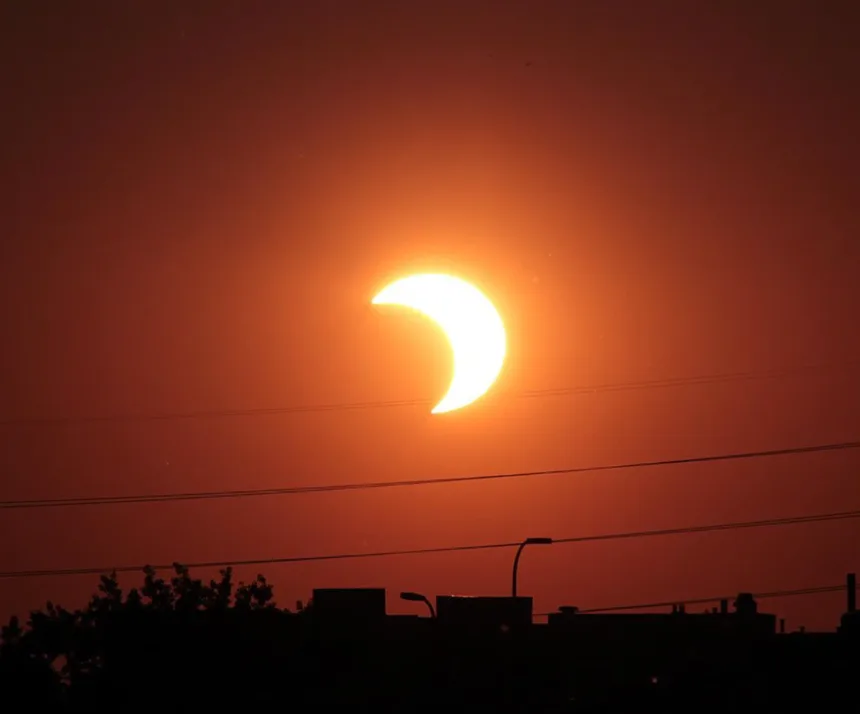
Back in August 1932, Charles Burchfield recorded his impressions of a near-total eclipse that he observed on the afternoon of the 31st in Gardenville, New York (1).
“This P.M. the solar eclipse – .91 total here – make smoked glass for all of us (2). The children excited – most beautiful at its greatest coverage – crescent shaped replicas of sun (inverted) quivering and trembling on the house & lawn, cast by the trees – especially beautiful on the house, tremulous & eerie. Inside the house, very dark, and the scene outside bathed in an ominous tawny light, eerie shadows – the sky a dark leaden color.” August 31 1932
As maximum coverage approached, Burchfield noted the beauty of the “crescent-shaped replicas” of the sun’s image on his shadowed house and lawn caused by tiny gaps between the leaves that acted like pin-hole light projectors of the sun’s semblance. When one recalls such works as “Sun Glitter” (1945) that Burchfield painted from the perspective of the southwest side of his house, one can imagine the effect evoked by multiple images of the eclipsing sun quivering upon the shadowed clapboard. One only wishes that Burchfield had tried to capture such a scene on paper, using his stereotypical, vibrating brush strokes to achieve such a “tremulous” effect.
In his journal entry from the 31st, Burchfield also mentioned the “ominous tawny light,” the “eerie shadows,” and a “leaden”-colored sky. All these are striking features of the land and skyscape that we can expect to see as the eclipse in Buffalo approaches totality. Each of them is apparent in a painting “September Sunlight” that Burchfield did make later in 1932 (3).
About this painting Burchfield wrote to the Fogg Museum:
“I think I was influenced in the lighting of this picture by the almost total eclipse of the sun of that year (91% at Buffalo). The half light was very strange, and when I painted this a few days later I was still under the spell of its weirdness.” (4).
In the scene, one observes the darkened, gray cast of both in the sky and the vegetation surrounding the house. The entire landscape is subdued. The bleached house and yard are washed in yellowish browns and greys, as are the reflections off the illuminated windows – all emphasizing the effects of the “tawny light”. The pale coloration stands in contrast to the sharpness of the shadowing from the roof, clapboard, and chimney. Here Burchfield has captured all the weirdness of the “half” sunlight of a September afternoon – emulating the illumination of the partial eclipse that so captivated him earlier in the summer. For Buffalo eclipse viewers these lighting effects should be apparent just prior to totality.
We have Charles Burchfield to thank for recording, in words and by brush, these unusual indicators of a solar eclipse. His impressions of the strangeness of the partial solar eclipse of 1932 portray what we too can look forward to as time draws close to totality on the 8th. The eclipsing sun will undoubtedly command our attention. However, Burchfield reminds us to not to neglect the scene around us “bathed in an ominous tawny light”, and to let the “half light”, the “eerie shadows” and “the sky a dark leaden color” captivate us by its weirdness.
Notes:
- Burchfield, Charles Ephraim, and J. Benjamin Townsend. Charles Burchfield’s journals: the poetry of place. State University of New York Press, 1993. p. 234.
- CAUTION – DO NOT USE this method to watch the sun before the eclipse on April 8. Please use ONLY certified viewing glasses to observe the sun.
- 1933.28: Old Farm House (September Sunlight) https://harvardartmuseums.org/collections/object/306651?position=1&context=person&id=30321
- Benjamin Rowland, “Burchfield’s ‘Seasons'”, Bulletin of the Fogg Art Museum, Fogg Art Museum (Cambridge, MA, November 1946), vol. X, no. 5, pp. 155-161.