More than two thirds of water treated by Niagara Falls Water Board is ‘unaccounted for’ in 2015
The recently published Niagara Falls Water Board’s Annual Drinking Water Quality Report for 2015 disclosed that more than two thirds of the city’s treated water was never sold to customers.
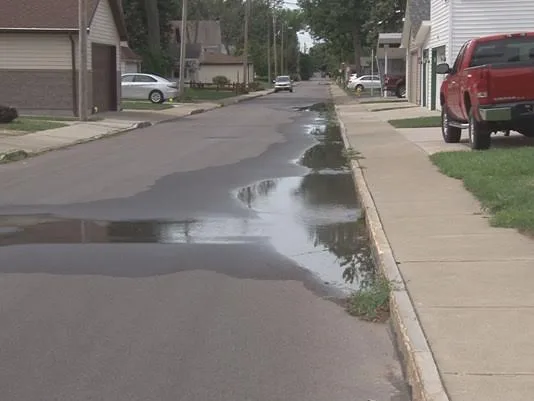
The report may offer a clue as to the severity of the underground water leakage problem in the city.
The Water Board estimates it has 50,000 customers who are delivered potable drinking water through 17,000 service connections.
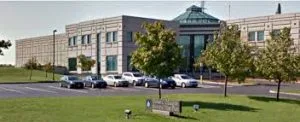
The Water Board treats water at the Michael C. O’Laughlin Water Treatment Plant on Buffalo Avenue.
According to the report, “The total water produced in 2015 was over 7.7 billion gallons….. The annual amount of water delivered to customers was about 2.5 billion gallons. This leaves about 5.2 billion gallons unaccounted for.”
This means that 67.5 percent of the water treated was unaccounted for.
The report explains, “Unaccounted for water includes such conditions as flushing of water mains, meter inaccuracies, illegal consumption, fire hydrant usage, authorized unmetered usage (street cleaning, etc.) and underground pipe leakage.”
Wherever the water actually goes, Water Board customers bear the cost of converting 7.7 billion gallons of river water into drinking water, while they consume and pay for only 2.5 billion gallons, or less than one third.
Niagara Falls water customers currently pay $4.18 for every 1,000 gallons that is accurately recorded by Water Board meters.
The cost of treating two thirds more supply than the demand must be factored into the cost for customers. In order to consume 1000 gallons of water, the Water Board must treat 3,000 gallons of water of which 2,000 gallons will be unaccounted for.
The method of how 7.7 billion gallons of water is treated is explained in the report. “At a Low Lift pump station, water (taken from the Upper Niagara River at an intake) passes through screens to remove excess debris. It is then pumped to the pre-treatment tanks where chlorine is added as a disinfectant. Powdered activated carbon may also be added during the summer months to aid in taste and odor abatement. In the rapid mix chamber, poly-aluminum chloride (PACl) is then added to enhance particulate removal. The water then travels to the flocculation basins. These basins gently mix the PACl and any particles, allowing them to form a floc. The water then travels to sedimentation basins and the floc settles to the bottom of the basins. The water then flows into rapid sand filters. The filters remove any particles that remain. After filtration, the treated water is chlorinated again and stored in reservoirs before being pumped into the distribution system. The Niagara Falls water system adds fluoride in order to provide consumers dental health protection. And there is a fluoride addition facility. A Poly-Orthophosphate blend is also added to the water to prevent household lead and copper contamination.”
It may be that the high percentage of unaccounted for water is the cause of the higher price of Niagara Falls water.
The Erie County Water Authority’s Annual Drinking Water Quality Report for 2015 reveals an almost inverse ratio of unaccounted for water to accounted for water.
The Erie County Water Authority produced 25.7 billion gallons of potable water for 35 municipalities throughout Western New York. Approximately 16.5 billion gallons were sold to customers.
While the Niagara Falls Water Board had 67.5 percent of water unaccounted for, Erie County reports they could account for (i.e sold to customers) 64.2 percent of their water, while 35.8% percent was unaccounted for which they explained was “used for flushing water mains, fighting fires, training firefighters, filter backwashing, plant processes, equipment and hydrant testing and lost to leaks.”
Erie County charged its customers $3.05 per thousand gallons in 2015, which is more than a dollar cheaper than the cost per thousand gallons in Niagara Falls.
The Niagara County Water District in Lockport’s Annual Drinking Water Quality Report for 2015 discloses the district serves approximately 150,000 people through 108 service connections to Towns and Villages located in Niagara, Erie, and Orleans Counties.
The total amount of water delivered to customers in 2015 was 5.6 billion gallons. The total water produced in 2015 was 5.72 billion gallons. This leaves an unaccounted for total of 1.2 million gallons or 2.2% of the total amount of water was unaccounted for.
“This water is used to flush mains, fight fires and is lost due to leakage in the distribution system,” their report reads.
In 2015, Niagara County water customers were charged 75 cents per 1,000 gallons of water.
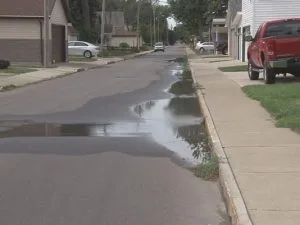
Niagara Falls Water Board Executive Director Paul Drof admitted there are “hundreds” of water line breaks all across the city. He said he did not know how much water has been lost, adding that the Water Board continually responds to breaks throughout the city, two to three a day.
“Yes, people are calling. Yes, we are embarrassed and yes, this is irritating. We are trying our best to get to them, but we have to reassess daily,” Drof told the Buffalo News.
Ironically, while the Niagara Falls Water Board can’t account for most of its water, and as people in other towns and cities in Western New York pay lower prices for water, an audit released by state Comptroller Tom DiNapoli revealed that the Niagara Falls Water Board had a $6.3 million surplus that could have been used to fix leaks or lower water rates.
Toward the end of the Niagara Falls Water Board’s Annual Report a heading reads “WHY SAVE WATER AND HOW TO AVOID WASTING IT?”
This section notes that “You can play a role in conserving water by becoming conscious of the amount of water your household is using, and by looking for ways to use less whenever you can. It is not hard to conserve water. … ¨ Automatic dishwashers use 15 gallons for every cycle, regardless of how many dishes are loaded. So get a run for your money and load it to capacity. ¨ Turn off the tap when brushing your teeth. ¨ Check every faucet in your home for leaks. Just a slow drip can waste 15 to 20 gallons a day. Fix it up and you can save almost 6,000 gallons per year. ¨ Check your toilets for leaks … . Fix it and you could save more than 30,000 gallons a year. “
The Water Board suggests that when consumers save water, it will save them money since it will “reduce the cost of energy required to pump water, pumping systems and water towers” operated by a Water Board that pumps billions of excess gallons per year that the public does not consume.
The high percentage of unaccounted for water is not a new phenomenon either. Annual drinking quality reports from 2011-2015 consistently show more than 50 percent of water treated is unaccounted for in Niagara Falls.
Read the report at http://nfwb.org/reports/quality/