Toxic Niagara Sanitation landfill still plagues Town of Wheatfield
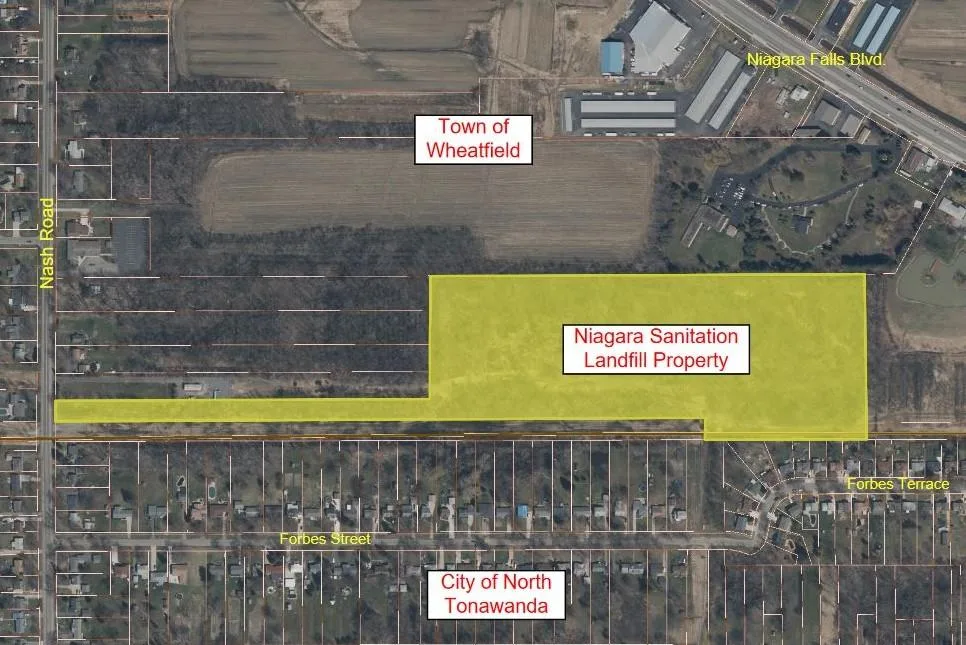
Government officials propose new fence to contain toxic below-ground leachate
Foot-dragging over decades by the Town of Wheatfield and the state Department of Environmental Conservation (DEC) in their efforts at testing and remediation of the former Niagara Sanitation toxic landfill in the town has some residents of Nash Road frustrated to the extent that they are suing the government for action.
It was way back in 1983 that the DEC first conducted a “Phase I Investigation,” which consisted of “historical records review and site walk over.” Then two years later the state agency commenced Phase II, on-site data collection. It took another four years before that Phase II investigation was “expanded” in 1989.
So altogether, it was approximately six years before the powers-at-be even got to the point of admitting that “Houston, we’ve got a problem.” Since the disaster of Love Canal, which in fact had been partially removed to the Nash Road dump as part of the excavation and construction of the Lasalle Expressway, was fresh in everyone’s memory, it didn’t come as news to the nervous residents of Nash Road and surrounding area.
Then another two years elapsed before the New York State Department of Health got into the act, sampling surface soil to further evaluate “potential exposure risks” in 1991.
What they found after all that time, and innumerable testing procedures, was that “… the Site did not pose a significant threat to public health or the environment because the exposure was limited; the wastes were buried, contained or sufficiently covered to avoid significant exposure. Groundwater as a potential exposure path was also limited because the area was served by public water and the closest private well was approximately one mile away,” according to state documents.
Whew.
More than 20 years later, however, in 2013, the DEC reopened its investigation of the long abandoned (closed in 1968) Niagara Sanitation landfill, due to complaints by local residents of elevated rates of everything from skin rashes, respiratory ailments and thyroid issues to cancers, birth defects and more.
They are alleging that, while testing of surface soils and water run-off in their neighborhoods adjoining the landfill have tested negative, the numerous and varied poisons are leaching into their basements via peripheral subsurface water movements out of the toxic dump. That is eerily similar to how the Love Canal emergency initially unfolded.
For the record, “The landfill accepted both municipal and industrial solid wastes, including caustic materials, plating tank sludge, fly ash, salt solids, graphite, carbon, scrap adhesives and miscellaneous laboratory chemicals. NYSDEC records indicate that Bell Aerospace, Carborundum, Graphite Specialties and others disposed of waste at the site,” as listed by the DEC.
In 2014 it was determined that the Niagara Sanitation site also had hazardous levels of lead and polychlorinated biphenyls (PCBs). Lead is a potent neurotoxin associated with permanently lowered IQ in children. PCBs, primarily used to insulate electrical transformers, are possibly the most toxic chemicals known to mankind, being carcinogenic, neurotoxic and endocrine disruptors.
Even though it’s what’s taking place below the ground that has residents up in arms and is alleged to be making them sick, Wheatfield Supervisor Robert Cliffe and the DEC seem to think fencing off the area is a solution to the dangerous situation.
“There’s nothing I would love more than to put that fence up,” he told Channel 4 News.
“ATV’s are a real problem,” he continued, “ATV’s and power bikes are, bicycles, off dirt bikes, churn the soil up and dig trenches down to where the material is,” although, according to the state, “The property is… overgrown with mature trees, dense brush, and patches of phragmites (a common tall weed),” and features “wetlands on the western, northern and eastern portions of the property,” and the toxic waste is “covered with 12 feet of fill.”
It’s estimated that the fence will cost $150,000, with the town and state sharing the cost equally. That’s a substantial amount of money, given that its beneficial effects will be mostly psychological.