Niagara Falls
THE
NIAGARA FALLS REPORTER
LOCAL NEWS  •  LOCAL VOICES  •  LOCAL MATTERS

State Parks neglects DeVeaux Carriage Barn
N
Niagara Reporter-  ·  July 14, 2017
State Parks neglects DeVeaux Carriage Barn
SharefXin

Historic building may soon be razed

Even though the local State Parks office reaps $20 million annually from its operations in Niagara Falls State Park and $3 million a year from Niagara Greenway, it seems they can’t spare a few dollars for a new roof on the historic DeVeaux Woods Carriage Barn, and insiders say the distinguished and celebrated structure is again, as it was a few years ago, under threat of being flattened by their wrecking ball.

Formerly the location of a private school attended and fondly remembered by hundreds of local residents, the grounds of DeVeaux Woods State Park feature several buildings, the oldest of which is the Carriage Barn, a brick structure built in 1863, the same year President Abraham Lincoln delivered the Gettysburg Address.

State Parks wanted to knock it down back in the spring of 2011, but local residents and city politicians mounted a frenzied, last minute and ultimately successful appeal to the state agency to reconsider its ill-advised decision.

At the time, with demolition only days away, local historian, author of numerous books about Niagara Falls and frequent State Parks honoree Paul Gromosiak tipped off the Niagara Falls Reporter, which alerted the public in a series of articles of the impending outrage against our history and our heritage. State Parks relented, put up some “No Trespassing” signs, slapped a tarp over the badly-deteriorated roof and walked away, granting a reprieve for the stately Civil War-era building.
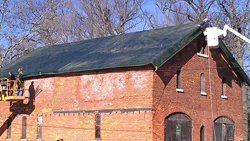
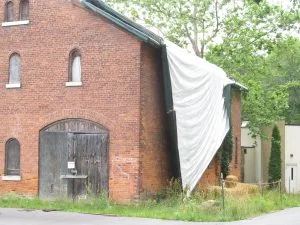
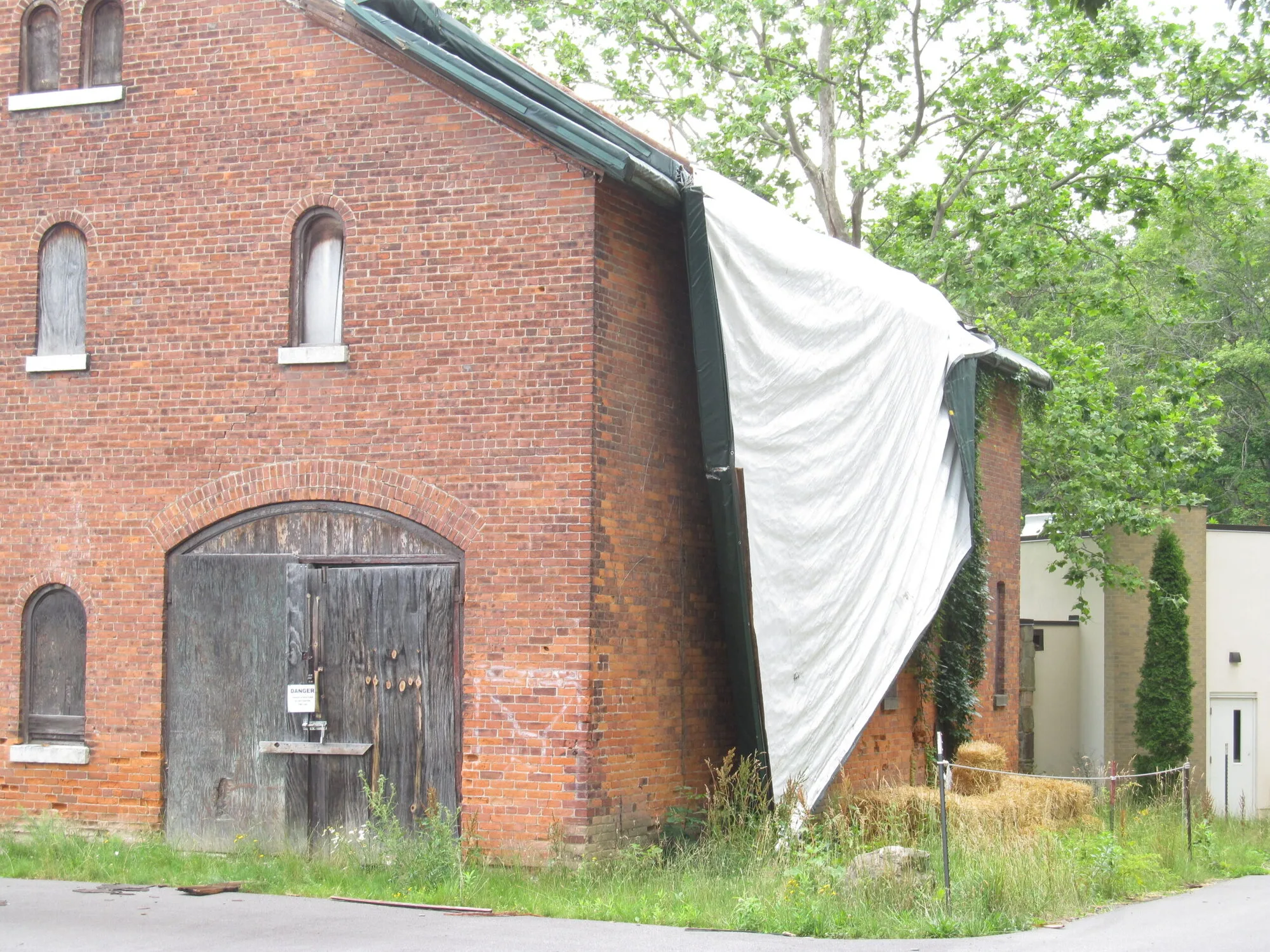
State Parks protected the DeVeaux Woods Carriage Barn roof (above) in 2011 following a massive public outcry over its plan to destroy the historic building. The flimsy covering now hangs off the building (below) months after a windstorm damaged it.

IMG_0203

Then came the devastating windstorm of March 8, 2017, with gusts in excess of 80 mph causing widespread damage and power outages across Western New York and particularly Niagara Falls. The makeshift tarpaulin protecting the Carriage Barn was violently blown off, completely exposing the decayed wooden rafters and interior of the building, which is listed on the National Register of Historic Places, to the elements. And State Parks has clearly made no effort during the ensuing three months to address the situation.

“I’ve heard the state is going to demolish the structure,” a city preservation advocate, who wished to remain anonymous, told us three days ago, in a near panic, “demolish as in sometime this week!”
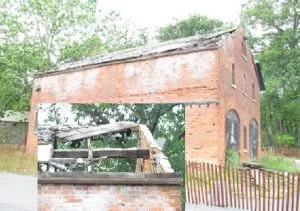
Close-up (inset) of the sorry state of the Carriage Barn. Sorry to say, it's condemned to rubble, unless the city acts fast to convince State Parks that it must be saved.
Close-up (inset) of the sorry state of the Carriage Barn. Sorry to say, it’s condemned to rubble, unless the city acts fast to convince State Parks that it must be saved.

The powers-at-be who are in a position to call the shots with regards to what takes place on state parkland here in Niagara Falls should take note of a 2002 court case initiated by the Preservation Coalition of Erie County, which sued the state over its neglect of the H.H. Richardson complex on Elmwood Avenue in Buffalo, a 19th century psychiatric campus that was designated a National Historic Landmark.

Vacant since 1974, the architectural masterpiece was being allowed by the state to deteriorate beyond remediation when the Coalition took it to court under the legal premise that if the state owns such an historic landmark building, it needs to do more than sit on its hands decade after decade until the edifice disintegrates.

It was also a test case of a state law that had been sponsored by a certain late Assemblyman Bill Hoyt, father of Empire State Development WNY Regional President Sam Hoyt, which required the state to maintain landmark buildings that it owns. How ironic would it be for the Carriage Barn to be torn down during Sam’s watch?

Today, the H.H. Richardson complex is the site of a signature hotel, resort and conference center in downtown Buffalo.

It’s no surprise that Niagara Falls City Councilman Ken Tompkins has already “stepped up to the plate” and is working to save the Carriage Barn.

“(State Senator Robert) Ortt’s office is helping me on this,” responded Tompkins to our inquiry, “I’ve reached out to (Western District Director and newly-minted Assistant Deputy Commissioner) Mark Thomas and to (Assemblymember) Angelo Morinello and our (Niagara Falls) Historic Preservation Committee.”

It’s time the NYS Office of State Parks, Recreation and Historic Preservation lived up to the “Preservation” part of its name, and spent some of the riches they accrue from our local tourism industry to repair and reuse the DeVeaux Woods Carriage Barn, which could also serve as a useful attraction for the adjacent Schoellkopf Hall, which is the lead candidate in a recently-released State Parks RFP for a proposed “lodge.”
SharefXin

Comments (0)

Leave a comment

More From Niagara Falls Reporter

Craig Bucki Stands Out in Race for Supreme Court, Has All the Tools to Be Strong Judge
Featured

Craig Bucki Stands Out in Race for Supreme Court, Has All the Tools to Be Strong Judge

By tony Farina · September 16, 2026

By Tony Farina I’ve covered many court proceedings and trials in my more than 35 years as a newspaper and television reporter and I want to make the point at the beginning of this story that whether elected or appointed, some judges are fair and honest and many others fall short of the mark. In other words, the word jurist does not convey skill and knowledge of the law; it is just a role that some serve with distinction, and others do not. By definition, a jurist is a person who has expert or thorough knowledge of the law but

Is Niagara Falls Crisis Self-Inflicted? Lots of Questions, Few Answers
Featured

Is Niagara Falls Crisis Self-Inflicted? Lots of Questions, Few Answers

By tony Farina · September 15, 2026

By Tony Farina There are certainly many questions swirling around the mayor’s declaration of a state of emergency in Niagara Falls over trash, blight, and deteriorating streets that was declared back on July 20 and has been extended several times since because, according to Mayor Robert Restaino, the City Council refused to approve contractor agreements. But some observers point to depleted staff at City Hall, like in Public Works and Code Enforcement and other departments, as really self-inflicted wounds that are the underlying reasons work is not getting done in the city. Or is there even more to the story,

NIAGARA FALLS BUILT THE MODERN WORLD ON ITS POWER. IT CAN DO IT AGAIN.
Featured

NIAGARA FALLS BUILT THE MODERN WORLD ON ITS POWER. IT CAN DO IT AGAIN.

By Niagara Reporter- · September 11, 2026

The  Data Center That Answers Hochul’s Objections There was a time when Niagara Falls did not ask Albany whether it was permitted to prosper. The river was here. That was enough. The town had something Albany couldn’t give it. It used what was here. Water. Power. Work. Jobs. Industry. A future. In 1895, the Adams plant took the river and put it into wire. The current went to Buffalo. It changed the industrial world. Tesla supplied the designs. Westinghouse built the machines. Niagara supplied the falling water. Then industries came. Electrochemical. Electrometallurgical. They came because Niagara offered abundant, inexpensive electricity.

Niagara Falls Has Millions of Tourists But Needs to Find a Way to Capture That Wealth
Featured

Niagara Falls Has Millions of Tourists But Needs to Find a Way to Capture That Wealth

By tony Farina · September 8, 2026

By Tony Farina The City of Niagara Falls, N.Y., boasts one of the world’s greatest natural wonders that people from around the world come to see, but despite incredible tourism numbers of more than nine million visitors a year, the city of now less than 50,000 people is still pretty darn poor. Niagara Falls does not have a tourism problem; it has a tourism-capture problem, and the distinction should be a starting point for a serious new discussion about the city’s future. And ladies and gentlemen, that discussion needs to start now. The question is no longer whether Niagara Falls