Radioactive Spoils Pile on North Ave. has been removed!
Frank Parlato
Niagara Falls – The spoils pile at 915 North Ave. – which had signs around it warning: “Caution Radioactive Materials Area” –was removed earlier this month, along with the chain link fence surrounding it.
The pile had sat on an abandoned lot for more than a year– near a densely populated part of the city. The Dyster administration made no official announcement of its removal or where it went.
New York State law (6 NYCRR part 380) bars landfills in New York State from accepting radioactive waste and it is believed to have been delivered to the US Ecology EQ Wayne Disposal landfill in Belleville, Michigan.
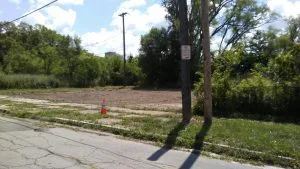
A graded vacant lot with topsoil and weeds is how the site appears now.
Whether residue of radioactive materials is still onsite has yet to be determined.
The public first voiced concerns about the potential danger of the spoils pile after The Reporter’s story of June 23 alerted the community to its existence.
The Reporter noted the pile, of approximately100 tons of soil and crushed rock, had yellow hazard signs around it, inside a fence, that warned that it was radioactive.
We reported the gate to the fence was bowled over and the plastic sheet covering it was tattered permitting particles of potentially hazardous material to become airborne.
A year or more of rain, snow, wind and official neglect may have scattered toxic substances, infiltrating the air and perhaps drinking water as well.
After the Reporter broke the story, the city fixed the fence, and plastic covering.
The story prompted concerns however that sitting above ground, a few hundred yards from a densely populated neighborhood, was radioactive material too dangerous to bury in landfills anywhere in the state.
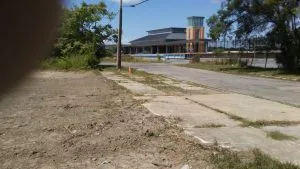
The spoils pile, we learned, came from excavations from the new train station located a few hundred feet away.
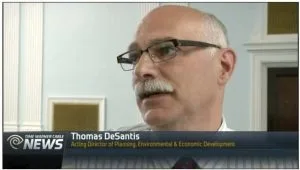
After other media reported on our story, Niagara Falls Senior Planner, Thomas J. DeSantis told reporters the spoils pile was harmless.
Mayor Paul Dyster told The Reporter the pile presented no serious public safety threat and that he personally held the materials in his hand.
The Dyster Administration did not release an Environmental Impact Study or laboratory analysis to corroborate their claims. An analysis would have tested for uranium, radium, thorium, and plutonium.
DeSantis told the media that the “exact isotope” was irrelevant emphasizing that the soil “has a low level of radiation.”
Test reports did show the presence of radium, he admitted.
The isotope referred to is believed to be radium 226, which, scientists have learned, mimics calcium. If ingested, even in microscopic quantities, the body sends radium 226 to teeth and bones where it can cause leukemia and bone cancer. Radium 226 has a half-life of 1600 years.
“It’s not contaminating anything, the levels are so low that they don’t cause a health threat,” DeSantis repeatedly assured the public. “It’s safe to any-body walking by. It was never abandoned and it was never a threat. We dig it up and then we segregate it”
Modern science however does not agree.
The U.S.E.P.A. warns that “all exposures to ionizing radiation carry a risk for inducing an associated disease.”
The Beir -VII report by the National Academy of Sciences in 2005 states there “is no safe dose of radiation no matter how small.”
DeSantis told the Niagara Gazette that the radioactive warning signs that had been posted by the city’s environmental contractor were “unnecessary,” and he took them down weeks before the spoils pile left for Michigan.
When questioned by the Gazette about his expertise on radioactive material and their handling, DeSantis demurred, admitting he actually was not the “appropriate” person to speak to on this matter.
Is there any way of proving Dyster- Desantis’ claims that the radioactive spoils pile posed no threat to human health?
A Geiger counter reading taken by the Reporter at the exposed site, before it was removed, showed the spoils pile exceeded natural background radiation rates by orders of magnitude, or by at least 1000 times what should be considered natural for any area.
By DeSantis calling it low level radioactive waste, it only means, even if he doesn’t understand it, that the risk of cancer is lower, but it still exists.
Radiation weakens and breaks up DNA, damaging cells enough to kill them or causes them to mutate in ways that lead to cancer.
No one, even if they hold it in their hand, feels the health hazards immediately.
And radium is considered very harm-ful since it has long biological half-lives and the radiation has a high relative biological effectiveness, making it more damaging to tissues per amount of energy deposited.
Radioactive elements have been found in similar sites around Niagara Falls and Niagara County when radioactive waste was buried under roads and parking lots, decades ago.
When tearing up a road in Niagara Falls, where radioactive material is buried or moving a radioactive spoils pile, it creates an inhalation hazard to the surrounding commu-nity which can manifest as cancer 20 years later.
If someone breathes in a particle of uranium, for example, it can lodge in their lung. As each atom decays, the uranium emits alpha particles that pack millions of electron volts—that’s what makes a Geiger counter click—more than enough to damage or break a strand of DNA or RNA.
These alpha particles can only travel about six cell diameters, so a tremendous amount of potentially destructive energy is concentrated in a very small area of the lung.
Cancer is known to start from the aberration in an individual cell.
Uranium, the parent of other radio-active materials that have seeped into the environment, is toxic to cells; it adversely affects DNA; it causes mutations in DNA; causes birth defects and is a neurological hazard.
For decades, the agencies charged with protecting communities ex-posed to radioactive materials insisted that the legacy waste produced in and around Niagara Falls did not pose a significant health risk.
And that is what the spoils pile on North Ave. probably was: legacy radioactive waste, unearthed with the train station excavation, after being buried for decades.
DeSantis, in arguing the relative safety of the spoils pile, drew comparisons to the Lewiston Road reconstruction project several years ago.
Radioactive waste was buried under the road and when it was dug up, DeSantis called it harmless.
“This material (on North) is similar to radioactive materials excavated as a function of (Lewiston Road) Project, which were similarly handled, monitored and disposed of under the direction of the (state Department of Health) and (state Department of Environmental Conservation),” he said.
DeSantis cited a “fact sheet” circulated by the Department of Environmental Conservation (DEC) regarding the Lewiston Road radioactive waste which is also called by the catch all term “slag.”
The document states that slag presents “no concern for public health,” but was supported by findings from nearly 40 years ago.
Back in the 1940’s and 1950’s, Niagara Falls was the premier city for experimentation, research, development and production of atomic bomb materials throughout the Manhattan Project and into The Atomic Energy Commission eras.
According to U.S. Department of Energy records, Niagara Falls was the largest production center for uranium metal-from-ore in the nation.
The material from which chemical companies refined radioactive isotopes came from ore – from Africa, the Yukon and the Colorado Plateau, mined from up to 1000 feet below surface.
Ore – with uranium in it – was transported to the Falls and radioactive elements from it were handled, enhanced, manipulated and produced in chemistry labs and metallurgical furnaces which were powered by Niagara’s abundant hydroelectric power.
After the radioactive elements or isotopes, consisting of primarily uranium 235 (U-235 or Fissel material) was extracted for use in bombs and reactors.
Because usable radioactive isotopes refined from the ore were in trace quantities, the refining process necessitated leaving significant amounts of remaining isotopes in the massive tonnages of waste associated with production.
99 percent of the ore remained as waste, including “depleted uranium”, remaining uranium, thorium and radium.
The waste was not returned to Africa, the Yukon or Colorado, but labeled “slag”, declared safe, and buried underground in various locations in Niagara Falls.
At the time, people were led to believe that buried under pavement the radioactivity in the slag would not penetrate the surface.
Scores of roads in Niagara Falls have radioactive material buried underneath them. Scientists have since learned that radioactive materials buried under roadways are not completely insulated or made “safe” by pavement over them.
Due to historic activities typically related to the radium industry, uranium mining, and military programs, there are numerous sites that contain or are contaminated with radioactivity.
Agencies that set safety standards for exposure to radiological materials have ignored new science that shows even small doses of so-called “low-level” radiation can have devastating health consequences.
Electro Metallurgical Company of Niagara Falls, New York, a subsidiary of Union Carbide, was the MED’s largest ore-to-metal uranium production plant. From 1942 to 1953, the plant processed uranium tetrafluoride (green salt) into uranium metal. The plant was also called the Union Carbide and Chemical Electro-Metallurgical Division Works.
Linde Air, Titanium Alloys Manu-facturing, National Lead, Harshaw Chemical, Hooker Chemical, and other plants contributed to the creation of the atom bomb, and were rewarded for their work.
When the war ended Niagara Falls in-dustry continued to win lucrative de-fense contracts and play a role in nuclear esearch for decades to come.
A lot of the waste was buried here. One of those piles came to the surface and now it is gone.
There are many more spoils piles just like it waiting to be unearthed,