Partisan gerrymandering maintains Incumbents, Subverts will of New York State voters
N
Niagara Reporter- · October 20, 2016
SharefXin✉
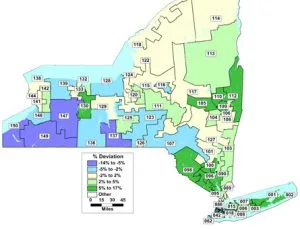
Democracy is on life-support in this country, especially in New York State, and here’s why.
Spending by super PACs, and in New York through the so-called LLC loophole, is an enormously corrupting influence on the integrity of our political system. Unlimited money flowing into campaigns, necessitating that public officials expend more time and effort fundraising than they do actually governing, is problematic, considering the pay-for-play strings attached to those contributions that mainstream politicians collectively acknowledge but individually deny.
Second, cross-endorsement resulted in the virtual appointment of two local State Supreme Court candidates last year. The party bosses gathered in the proverbial smoke-filled room and wheeled and dealed and picked our judges, with the voter having no say in the matter. According to the Buffalo News, “roughly half – 23 of 47 – of all State Supreme Court elections since 1995 were essentially decided by Erie County’s Republican and Democratic chairmen via cross-endorsements.”
Internal coordination within a political party can guarantee that a retiring elected official is succeeded by a hand-picked replacement. For example, Assemblywoman Jane Corwin and Niagara County legislator Richard E. UpdeGrove both announced this fall that they were stepping down near simultaneous with the deadline for filing petitions to run for their seats, thus precluding any primary contest, awarding the newly-opened ballot line to a connected insider.
Then there’s the abysmal voter participation rate. How hotly-contested are US presidential elections, really, when less than half of registered voters bother to vote? The turn-out for the Erie County primary election two months ago was so low (11%) as to be scandalous.
Finally, the hallowed American tradition of “one person, one vote” has never been more under siege, and nowhere more than here in New York, thanks to government of, for and by incumbent office holders. We’re talking about the practice of gerrymandering.
Gerrymandering is defined as the act of manipulating the boundaries of election districts in order to favor, or give electoral advantage to, one candidate or political party over another.
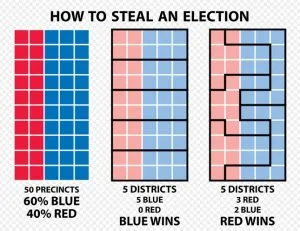
The practice is as old as the nation itself: In 1788, Patrick Henry (of “give me liberty or give me death” fame) and his allies, acting from the Virginia House of Delegates, attempted to gerrymander future-President James Madison out of a seat in the newly-formed US Congress.
The term “gerrymander”, coined a couple of decades later, is an amalgam of “salamander”, the twisty, slimy amphibian that hangs out in streams and puddles, and Massachusetts Gov. Elbridge Gerry, who in 1812 signed a bill that assured his party’s control over the state senate which, given the Democrats’ control of Massachusetts politics over the ensuing two hundred years, has also been characterized on occasion as twisty and slimy.
Have you ever wondered why there are two sparsely-populated North and South Dakota states, instead of one State of Dakota? It’s because the 1889 Republican-controlled US Congress wanted double the number of Republican Senators and Congressmen coming to Washington, DC from the two new states that formerly comprised a single Dakota Territory. As a result, nearly 130 years later, North and South Dakota (combined population less than 2 million) wield twice the clout in the US Senate than does California (population nearly 40 million).
The negative effects of gerrymandering are compounded and particularly toxic here in New York State, since it’s the politicians, acting in self-interest, setting the boundaries. The upstate (Republican)-downstate (Democratic) dichotomy that’s long existed here in the Empire State seems to make it even worse.
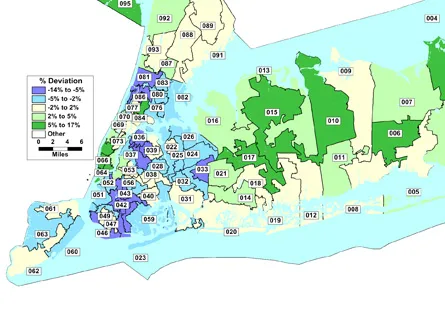
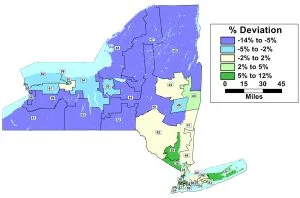
Upstate Senate districts and New York City Assembly districts have fewer constituents than state averages. That confers disproportionate power and influence to those residents, while diluting it for the rest. In addition, inmates of upstate prisons, most of whom are from downstate, are counted in the district in which they are incarcerated. This skews political power from urban to rural districts.
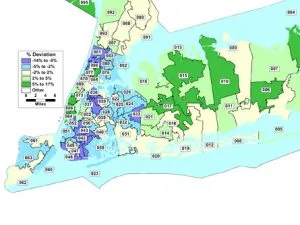
A handful of states employ non-partisan commissions to draw districts, and New York made cosmetic progress towards adopting such a system when it amended its state constitution in 2014 to form a new, 10-member Redistricting Commission, to set up shop in 2020.
According to the amendment, the Redistricting Commission will be composed of two members appointed by the president of the New York State Senate, two appointed by the speaker of the New York State Assembly, two each appointed by the minority leaders of the two houses, and two members appointed by their fellow eight commissioners who, in an apparent nod to minor parties, cannot be enrolled in the top two major political parties in the state. In other words, the Redistricting Commission will be under the direct control of the Albany politicians.
It’s actually far worse than it sounds. The Redistricting Commission will submit its plan to the legislature for approval. If the legislators vote it down twice, they can then proceed to amend it as they see fit, and then adopt it, completely negating the work of the Commission.
No wonder liberal groups like NYPIRG and Common Cause took a dim view of the “reform”. That’s because, with more than a 2:1 advantage of registered Democrats vs. Republicans statewide as of 2016, the Republicans, who have controlled the Senate for 48 of the past 50 years, will have ample means to perpetuate the status quo.
Gov. Andrew Cuomo negotiated the deal with the state legislature, which will serve to maintain Republican control of the Senate, continuing the record of “bipartisan cooperation” he wishes to capitalize on when he runs for the White House at some future date. Many pushed for a non-partisan, citizen-based commission, but it was not to be.
What have been the negative impacts of gerrymandering on New York, both locally and across the state? The main effect has been to create polarized districts where one party has a virtual monopoly on the seat. It’s so bad that in some cases, the opposition party hasn’t even bothered to put up a candidate.
For example, both State Senator Robert Ortt and 144th Assembly district candidate Michael J. Norris of Lockport are running unopposed. On the other side of the aisle, State Senator Tim Kennedy of Buffalo also is unopposed. If nobody’s running against these guys, then we don’t have an election, and voting is meaningless.
To be assured of re-election is tantamount to coronation, and unacceptable in a vibrant democracy which some purport us to be.
SharefXin✉