OPINION: Is It Time for The Gaza-Israel War to End? Evidently Not
Is It Time for This War to End? Evidently Not
BY: Mel Gurtov
In a major speech May 31, Pres. Biden offered a three-phase plan for ending the Israel-Hamas war, saying “it is time for this war to end.” (I have appended the White House outline of the plan to the end of this blog.) The proposal contains provisions for moving from a temporary to a permanent cease-fire, for exchanging all remaining Israeli hostages for Hamas prisoners, and for bringing the war to an end and providing for Gaza’s reconstruction.
The Biden plan, which will be put before the UN Security Council as a resolution, has many loopholes and uncertainties, such as failing to clarify the end game (see below). Still, the plan does provide the basis for movement toward an end to the war. Unfortunately, the plan may not have a ghost of a chance to gain approval from either side.
The Obstacles
The reaction from Prime Minister Netanyahu’s office to Biden’s plan indicates he is far from agreeing, even though Biden presented the proposal as an Israeli one. Yes, said Netanyahu’s office, he had “authorized the negotiating team to present a proposal,” but it was one that would “enable Israel to continue the war until all its objectives are achieved.” A second statement was even blunter, calling the plan a “non-starter.” There followed a more official rejection. “Israel has not changed its conditions to reach a permanent cease-fire. That will only happen after our objectives are met including destroying Hamas’ military and governing capabilities,” an official said. Other Israeli officials also undercut Biden’s proposal by calling it “partial” and subject to “further discussions.”
In plain English: Israel will not trade ending the war on Hamas for the release of all the hostages. Nor will it agree to a permanent cease-fire unless and until Hamas is completely destroyed. What does “completely destroyed” mean? The Netanyahu government will not permit anyone else, including the US, to define that term. But we can surmise what it means from two things: first, the Israeli Defense Forces’ (IDF) ongoing operations to reduce the Rafah area to rubble, and various reports suggesting that Israel means to root out Hamas fighters in the West Bank and then, this summer, make a major thrust into the West Bank and possibly Lebanon to subdue Hezbollah.
Hamas is equally determined not to yield on its main demands: a permanent cease-fire that would lead to a full withdrawal of Israeli troops from Gaza and the return of displaced Palestinians to their homes. Hamas resents that various US officials have been blaming it for the stalled negotiations and pressuring Hamas to take the deal as is. Israel’s rescue of four hostages actually lends support to Hamas’ position. At least 280 Palestinians were killed in the operation, which was assisted by a US intelligence unit based in Israel.
In a Bind
Israel’s apparent rejection of the Biden plan means that once again, Netanyahu has flouted the advice of his most important partner—in fact, has again put Biden in a humiliating position, having already defied the President when the IDF crossed his red line and moved against Rafah. Behind that matter is this: Each of the three main parties to this war is in a bind. Netanyahu desperately wants to deliver on the hostages but faces far-right cabinet members who are dismissive about the Biden proposal and are threatening to leave his government if he agrees to it. Benny Gantz, the opposition leader and one of three voting members of Netanyahu’s war cabinet, has just resigned from the government, carrying out his threat to do so unless Netanyahu came up with a plan for ending the war. Hamas has incentives to accept Biden’s proposal in order to regroup, but perhaps greater incentives to reject it and further isolate Israel. Hamas leaders evidently believe time is on their side. Biden needs his plan to succeed for the obvious political benefits at home. But if Israel or Hamas rejects his proposal, or keeps playing for time, Biden will have to decide whether to keep pushing Netanyahu at the risk of further rejections, or decide that finally it is time for the US, in its own best interests, to pull the rug from under Israel.
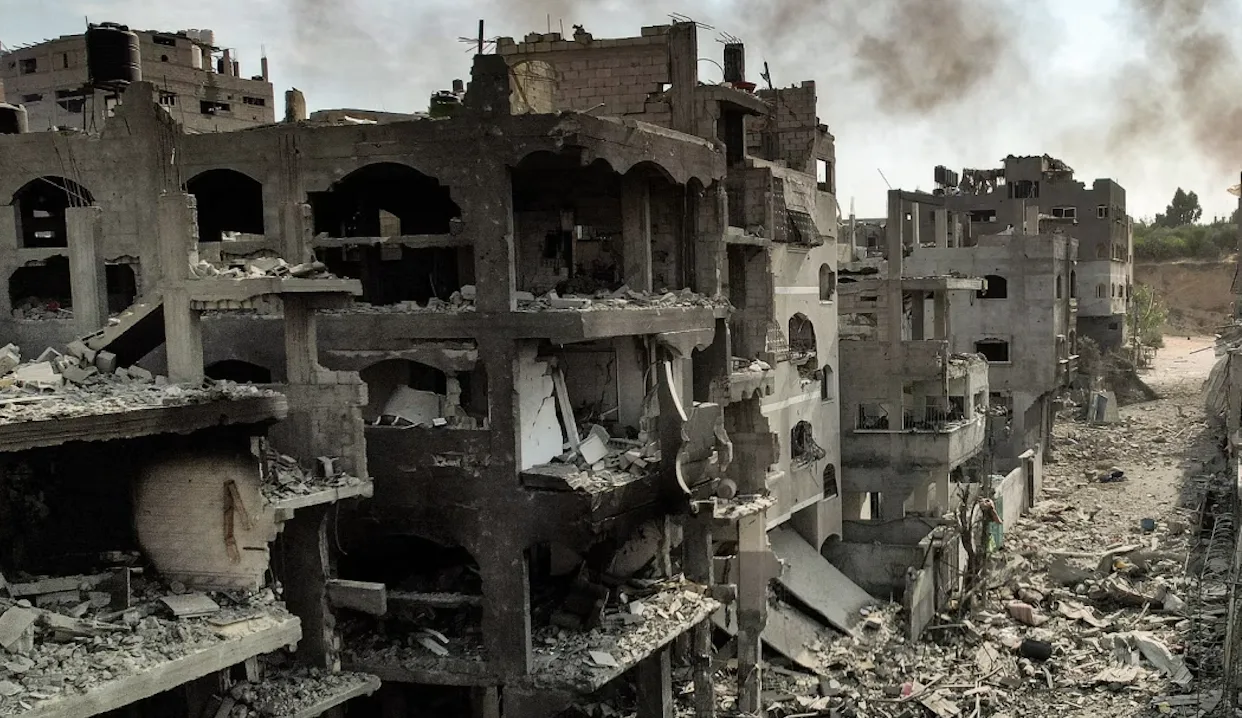
Let’s not forget that while the parties dicker over terms for a cease-fire, the war goes on in devastating circumstances. One account is that “Martin Griffiths, [UN] under-secretary-general for humanitarian affairs, says Gaza has become increasingly unsafe, making dignified human life “nearly impossible.” As a result, approximately 85 percent of Gaza’s population, totaling 1.9 million people, have been displaced, with half of them displaced in just one month. The scale of destruction surpasses previous events like the Nakba [The Catastrophe] in 1948,* with over 36,000 Palestinians killed since October 7. . . . analysis of satellite imagery indicates 80-90% destruction rates in the areas taken by Israel.”
(*A controversial paper by a Palestinian human-rights lawyer, , “Nakba As a Legal Concept,” published after initial suppression by the Columbia Law Review.)
Weaknesses and Loopholes in the Biden Plan
As to the proposal itself, even if Israel and Hamas were to agree to it in principle—that is, a temporary cease-fire leading to a permanent one, a hostages-for-prisoners exchange, and an end to the war—it would still contain all the challenges that any such proposal faces. Cease-fires are inherently difficult to arrange, monitor, and sustain. Violations are to be expected, but how to deal with them is often problematic. Numbers count: how many and which hostages for how many and which prisoners. And then there’s the “what next?” problem: the future of governance and security in Gaza, humanitarian aid, plans and payment for rebuilding Gaza, and prospects for establishing a separate Palestinian state.
Here are more specific problems I find in the three phases of the Biden plan.
In Phase 1, should the six-week cease-fire not lead to agreement on a permanent cease-fire, Israel is likely to reject further talks for fear that Hamas will keep stalling while regrouping for future attacks. Nor, for the same reason, is Israel likely to accept a troop withdrawal from populated areas of Gaza. These provisions, in the Netanyahu government’s view, restrict the IDF’s Rafah operation, go against his plans for carrying the war beyond Gaza, no matter the number of hostages released, and most importantly, leave Hamas in place. And if either side violates (or is charged with violating) the cease-fire, how will violations be handled?
In Phase 2, despite the completion of the exchange of hostages for prisoners and a permanent cease-fire, the disposition of Hamas forces is unresolved. Will they be disarmed, removed, left in place? Unless Israel is satisfied with the answer to that question, will the IDF leave Gaza? Hamas will insist on guarantees, including assurances that Israel will not find a pretext for re-inserting the IDF in the name of state security. Will the Palestinian prisoners be allowed to return to Gaza? And, who will govern Gaza given that Netanyahu firmly opposes a governing role for both Hamas and the Palestinian Authority? Finally, what does the US do if the cease-fire breaks down? (Is there a Biden red line?)
In Phase 3, the reconstruction of Gaza will take many years and many billions of dollars. Where will the money come from? Does Biden have hard commitments from any government? Will there be a quid pro quo for their financial pledges, such as agreement to a process for establishing a Palestinian state? (Note that the two-state idea is not mentioned in Biden’s proposal.)
The Biden Peace Proposal (White House Outline)
First Phase
Both sides would observe a six-week cease-fire. Israel would withdraw from major population centers in Gaza, and a number of hostages would be released, including women, the elderly and the wounded. The hostages would be exchanged for the release of hundreds of Palestinian detainees. Aid would begin flowing into Gaza, working up to some 600 trucks a day. Hundreds of thousands of displaced Palestinian civilians would also be allowed to return to their homes in northern Gaza. Most Palestinians fled the north following Israel’s mass evacuation order before the ground invasion began.
During the first phase, Israel and Hamas would continue to negotiate to reach a permanent cease-fire. If the talks take more than six weeks, the first phase of the truce will continue until they reach a deal, Mr. Biden said.
Second Phase
With a permanent cease-fire, Israel would withdraw completely from Gaza. All the remaining living Israeli hostages would be released, including male soldiers, and more Palestinian prisoners would be released in exchange. (In the past, the United States has said that the Palestinian Authority, which has struggled to run the West Bank, ought to be brought in to run Gaza. Israeli officials, including Mr. Netanyahu, have generally rejected either the Palestinian Authority or Hamas running Gaza.)
Third Phase
Hamas would return the remains of hostages who had died. Rubble would be cleared and a three- to five-year reconstruction period would begin, backed by the United States, Europe and international institutions.
Niagara Falls Reporter.