Niagara Falls City Council, Mayor Dyster exceed tax cap, cut Police
Budget Woes lead to big Tax Increases for Residents, Businesses
It took less than twenty minutes.
The meat cleaver came down hard on Mayor Paul Dyster’s proposed 2018 budget Wednesday afternoon, courtesy of the Niagara Falls City Council.
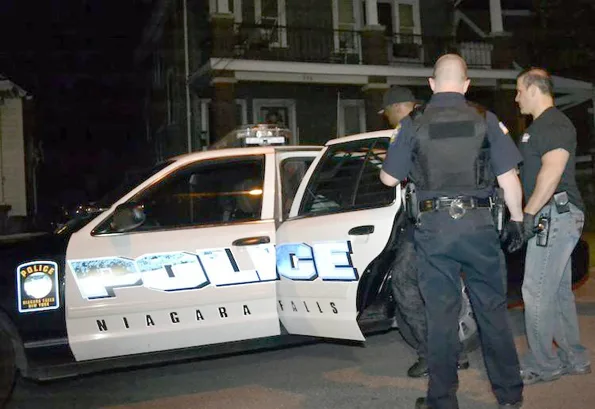
In short order, the council eliminated four police positions, paring the mayor’s proposed tax increases for 2018 down from 14.7% and 2.7% for businesses and residents, respectively, to 7.7% and 0.1%.
In addition, Councilwoman Kristen Grandinetti, Council Chair Charles Walker and Councilman Andrew Touma voted to allow the mayor to raise taxes in excess of the 1.84% state tax cap. Councilmen Ezra P. Scott, Jr. and Ken Tompkins voted in opposition.
“Councilman Scott and I believe that the businesses and homeowners should not have to pay for the last ten years of mismanagement,” Mr. Tompkins told the Reporter.
In contrast, moments before voting to raise taxes above the tax cap, Mr. Touma stumbled through a rather muddled justification from his seat on the dais. “Obviously, we don’t want to be penalized… (but) this is a safety net because we can’t get below, umm, the tax cap, so for that reason alone, I vote ‘yes.”
The New York State tax cap law, passed in June, 2011 at the behest of Gov. Andrew Cuomo in his one-size-fits-all effort to force his notion of fiscal discipline on schools, towns, villages, counties and cities in the face of numerous and burdensome unfunded state mandates, establishes a 2% limit on the annual growth of property taxes levied by local governments and school districts, or at the rate of inflation, whichever is less.
The inflation rate for the United States came in at 2.0% for the twelve months ended October, 2017, as published two weeks ago by the U.S. Labor Department. It has been near or below that level since the recession of 2007-2009.
For the Niagara Falls 2018 budget currently under consideration, the cap was set at the lower inflation figure of 1.84%, as announced by state Comptroller DiNapoli in July of this year.
The council-revised budget, which still exceeds the tax cap by nearly $250,000, now goes back to Mayor Dyster, who may veto or reinstate specific spending or revenue-generating items. It then returns to the council, which can sustain or reject the mayor’s final changes to the budget.
It’s likely that, in keeping with their record as a so-called “council majority” bloc, Councilman Andrew Touma will probably vote to rubberstamp Mayor Dyster’s final budget, as will Councilman Walker, and Councilwoman Grandinetti, who in fact registered the sole “no” votes on the police cuts that the mayor is likely to restore.
So despite their fervent and very conspicuous public exhibition, falling over each other to discover new, heretofore unidentified opportunities to salvage taxpayers’ money in the days leading up to November’s general election, the council, as presently constituted, is likely to give the mayor pretty much what he wants.
If approved, the 2018 total tax levy amount would also form the basis for calculating 2019’s tax cap.
“In the event that a local government successfully overrides the tax levy limit, the base for the following year’s tax levy limit calculation is the amount that was levied in the prior year…” says the state.
Therefore, whether Mayor Dyster’s final 2018 budget exceeds the tax cap by a little or a lot, Niagara Falls taxpayers will be subject to, for 2019 and succeeding years, what could be considered “reverse compound interest.”
Highlights of Mayor Dyster’s proposed 2018 budget, in the run-up to Wednesday’s meeting, included a 2.7% tax increase on residential property owners and a prodigious 14.7% boost for businesses, amounting to a 2.6% overall hike, well above the 1.84% cap.
A $870,000 increase over the 2017 budget would enable the city to still remain under the cap. Mayor Dyster is proposing a tax increase well over a million above that, or around $2.3 million.
“Right now they’re $900,000 or $1 million over the cap,” City Controller Daniel R. Morello told the Buffalo News on Monday.
By “they” Mr. Morello was referring to the City Council.
However, it was Mr. Morello’s boss, the mayor, who initially proposed, and has been pushing, the draconian tax increases, not the council.
It was the second documented time that the Dyster administration has publicly attempted to shift blame for the budget mess to where it doesn’t belong, the City Council, given that it is the mayor who originally formulates the budget and ultimately signs off on it, and whose policies over the past ten years are now coming to fruition in the form of a big fiscal headache.
Mr. Morello’s statement was consistent with Mayor Dyster’s previous comments, shirking responsibility for the budget fiasco in September when he told WGRZ-TV, “(The council) has chosen to use casino payments, rather than raise taxes, to pay for the same expenses.”
The budget, as it takes shape, is Mayor Dyster’s response to the cold, hard reality of vanished revenues from the Seneca Niagara Casino and associated businesses located downtown, and also the profligate spending that he has indulged in over the past decade.
All the nickel and diming and cutting of public safety positions that the Dyster administration is pursuing in its desperate effort to avoid default and a control board are also in the context of a new Amtrak train station ($23 million), south Moses Parkway upgrade ($20 million), new Public Safety Building ($48 million), Niagara Falls State Park Landscape Improvements ($50 million), north Moses Parkway “removal” ($42 million), Boundary Waters sculpture ($585,000) and all the cash that New York State Parks ($20 million), Delaware North ($5 million) and the New York Power Authority ($200 million) collectively drain from the city of Niagara Falls every year.