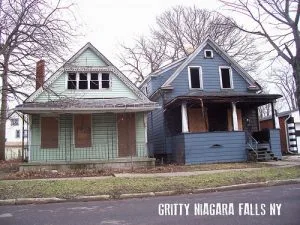
Niagara Falls also #1 when it comes to Crime, Poverty, Taxation
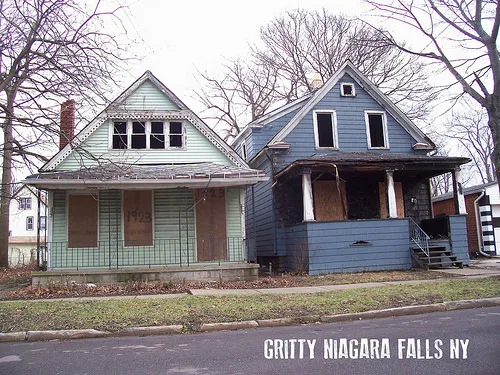
A dry-eyed look at the city of Niagara Falls though the cold lens of real statistics.
Crime
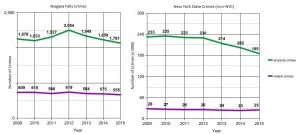
According to the September, 2016 FBI report “Crime in the United States”, there were 555 violent crimes reported in the city of Niagara Falls for the year 2015, including 3 murders, 32 rapes, 156 robberies and 364 aggravated assaults. Based on a population of 48,989, the rate of 113.3 violent crimes per ten thousand residents ranks Niagara Falls as the most violent city in New York State.
There were also 2,526 property crimes (burglary, car theft, larceny and arson) in 2015, at a per capita rate of approximately one property crime for every 20 people who live here. For cities with population over 30,000, that’s also, by far, the highest rate in the state (the next closest is Binghamton, with one property crime per 22 residents).
Niagara Falls ranked 44th on a recent list of the “Top 100 Most Dangerous Cities in the U.S.” compiled by NeighborhoodScout.com, derived from FBI and other law enforcement sources, and the U.S. Justice Department.
Poverty
According to recent US Census figures, 40.6% of children in Niagara Falls live below the poverty level, nearly twice the state average of 22.5%. The median income for a household in the city was $26,800 (New York State, $55,246), and the median income for a family of four was $34,377 (NYS, $72,170). 25.3% of the population of the city of Niagara Falls were below the poverty line, compared to a national average of 13.5%.
A partnership between the Oishei Foundation and the University at Buffalo’s Regional Institute determined the following in 2013: Roughly 22,425, or nearly one out of every two residents, are “doing poorly or struggling financially,” about 10,900 Niagara Falls residents, or more than 20 percent, live on incomes below federal poverty levels and another 11,525 city residents do not fall under the federal poverty threshold, but earn less than 200 percent of that line, making them eligible, in many cases, for public benefits such as SNAP, HEAP and ObamaCare subsidies.
Tax Burden
According to the prestigious and widely-referenced The Tax Foundation, Americans paid an average rate of 9.9% in state and local taxes in 2010, and the prize for the highest-taxed state was New York, at 12.8% (New Jersey was 2nd at 12.4%) (Note: New York has since moved up two notches, to third worst as of 2015).
Also according to The Tax Foundation, Niagara County residents perennially carry one of the heaviest property-tax burden in America. Business First reported in 2006 and 2008 that, coming in as the highest-taxed county in the nation, “(t)he typical Niagara County household (paid) $2,802 in property taxes each year, which equals 2.92 percent of the value of the typical home in the county, $95,800. That’s triple the national rate of 0.95 percent.”
According to Benchmarking NY, the Local Government Spending and Revenue database compiled by the Empire Center for Public Policy, an Albany-based think tank, the city of Niagara Falls comes in 15th among cities in the state in 2015, with a per capita total tax burden of $1063. It’s important to note, however, that cities with higher rates (the highest being White Plains, at $1979) are wealthier cities such as Saratoga Springs, Mount Vernon and Glen Cove, which have median incomes much higher than Niagara Falls. White Plains, for example, has an average household income of $116,846, more than twice that of Niagara Falls.
Therefore, what’s the bottom line on taxation? A reasonable argument could be made that the city of Niagara Falls is the highest taxed city, in one of the highest taxed counties, in one of the highest taxed states, of the United States of America.