NACC to open Underground Railroad exhibit before city’s is ready to go
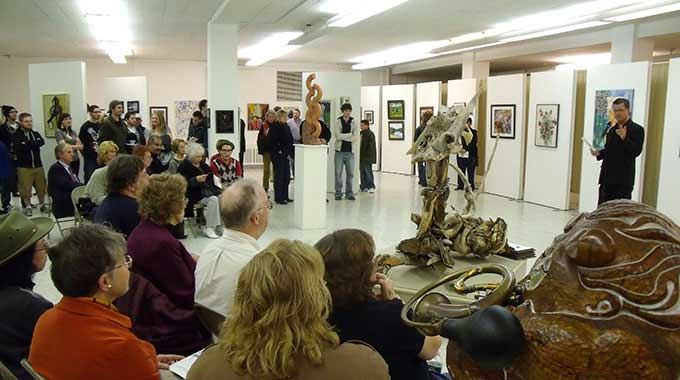
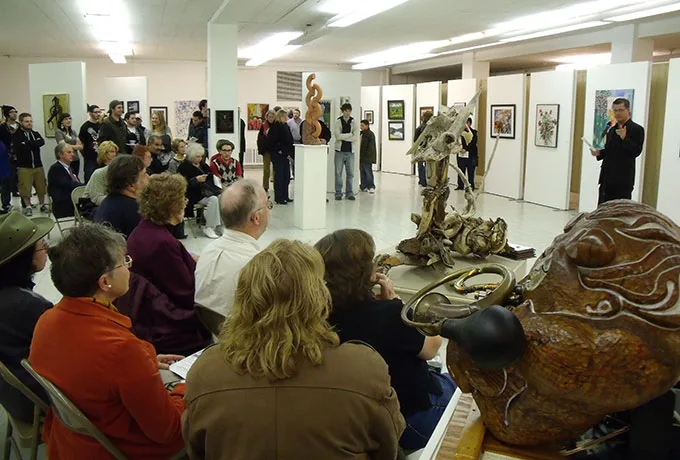
For Bill Bradberry, history is both an avocation and a passion. A decade ago, he became deeply involved when the Castellani Art Museum at Niagara University undertook its Freedom Crossing exhibit, and when Niagara Falls Mayor Paul Dyster announced the formation of an Underground Railroad Commission to mount an exhibition at the new Whirlpool Street train station, he was one of the first volunteers.
Few in Western New York know as much about the history of the Underground Railroad on the Niagara Frontier, and fewer still have been involved as deeply in the often political machinations that will likely lead to the secretive organization’s activities becoming a minor cottage industry here.
So when a tipster called the Niagara Falls Reporter to say that the Castellani had donated its entire exhibit to the Niagara Arts and Cultural Center, Bradberry was our first call.
It seemed odd that, with the Dyster administration having spent more than $3 million on putting together an Underground Railroad exhibit at the train station, that the Castellani’s extensive collection of artifacts, historic documents, books, audio and video tape wouldn’t go there.
“Not at all,” Bradberry said. “There is no competition whatsoever. In fact, the Underground Railroad Commission recommended that the Castellani collection be housed at the NACC.”
The Niagara River was often the last crossing for people escaping slavery in America. Escaping slaves faced an arduous journey, traveling mainly at night—on foot, in wagons, or by train or boat—to elude bounty hunters. From the early 1800s until the end of the Civil War in 1865, thousands of fugitive slaves passed through Buffalo Niagara on the Underground Railroad, as they traveled to freedom in Canada.
While the Castellani exhibit focuses on the history of the region – from Buffalo to Youngstown – during the pre-Civil War era in question, the 700-square foot interpretive center at the train station will be largely Niagara Falls specific, and deal with issues broader in scope.
The role of the most famous figure in Underground Railroad history, the controversial Harriet Tubman, will take a back seat at the train station center, Bradberry said.
As recently as 2009, city officials were claiming that Tubman personally led as many as 300 escaped, freedom seeking ex-slaves across the old Suspension Bridge in what is now the city to sanctuary in Canada.
A bit of research by the Reporter found this to be untrue. The 300 figure was entirely fabricated. She may or may not have assisted about 19 relatives escape slavery during her entire life and her only connection to Niagara Falls was that she may have once passed through what later became the city once as a passenger on a train.
The fact is there is no historical connection with Niagara Falls and Harriet Tubman whatsoever other than a single ride on a train after the end of slavery. Whatever exploits she had – and much of it is just legendary – happened elsewhere.
Still, city officials have announced that a life size statue of Tubman will grace a park bearing her name adjacent to the new train station.
“More important than the Tubman connection, I think, was the role of the Cataract House, both before the war, in the 1850s, and then afterward in making Niagara Falls a focal point of the great migration that occurred when African Americans became free to leave the Southern states and the Jim Crow laws and find a better life in the north,” Bradberry said.
Before the Cataract House burned down in 1945, for many years since its birth from the old Eagle Hotel/Tavern in 1825, it was a luxurious addition to the Niagara experience.
The Cataract House not only attracted, housed, entertained and fed well-heeled [white] tourists as well as local residents eager to see and be seen in the midst of high society, but as history clearly demonstrates, the hotel was owned by Gen. Parkhurst Whitney, an outspoken abolitionist.
The waiters and the stewards were all black people, the most famous of whom was John Morrison. Morrison was head waiter at the Cataract House during the most turbulent years of the Underground Railroad, and his efforts to help escaping slaves have been well documented, Bradberry said.
The activities at the hotel were well known to the point that the drew complaints from newspapers in the South.
“The proprietors of the Cataract House keep in their employ, as servants, a set of free negroes, many of whom have wives and relatives in Canada, and they have an organized plan of taking off all slaves that come to the house,” read an 1850s editorial in the New Orleans Times Picayune. “The Whitneys keep these fellows in their employ, knowing them to be engaged in this business; therefore it behooves all Southern people traveling North to avoid the Cataract House at the Falls of Niagara.
Bradberry said that the Underground Railroad Commission envisioned an installation at the new train station that would show how activities here during the antebellum period set the stage for the mass migration of southern blacks to the Niagara Frontier that peaked in the 1940s and 1950s.
In other words, the Underground Railroad itself will be just a part of the larger story the train station exhibit seeks to tell.
Bradberry said the train station exhibit is still in the “research stages”. For its part, sources familiar with the NACC plan say the exhibition there will be mounted in May.
Many questions remain.
Is the city of Niagara Falls big enough – or rich enough – to support two exhibits largely dedicated to the same subject?
And will enough tourists be interested in what largely amounts to black history for these museums or exhibits or interpretive centers to make a go of it?