Niagara Falls
THE
NIAGARA FALLS REPORTER
LOCAL NEWS  •  LOCAL VOICES  •  LOCAL MATTERS

Midtown arson recalls horrific Moonglow Hotel fire of 1957
M
Mike Hudson  ·  January 7, 2016
Midtown arson recalls horrific  Moonglow Hotel fire of 1957
SharefXin


s-l1600

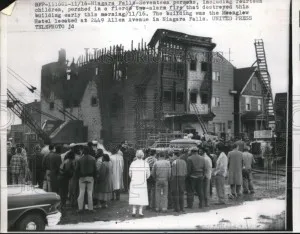
For some, last weekend’s torching of the Midtown Inn on Niagara Street brought to mind the Moonglow Hotel fire of November 1957. But while the destruction of the troubled Midtown may even be seen as something of a public service, the catastrophic Moonglow fire – which left 18 people dead including 15 children, was an epic tragedy that will never be forgotten.

The Moonglow was a decrepit rooming house that had recently been reopened by its’ owner, William Dietz, who was said to have bought the building in order to tear it down, as he was in the demolition business.

Dietz rented rooms to members of the city’s rapidly expanding African American community, mostly recent arrivals from the South who sought employment in the hospitality industry here.

Frances Haynes, who lives across Allen Avenue from the Moonglow, said the sound of an explosion awoke her around 4:30 a.m. on November 16.

She looked out and “saw flames pouring out of a window on the second floor of the house across the street.” By the time she had awakened others in her own house, “we looked again and the entire building was in flames.”

Ironically, it was Dietz’s father, Niagara Falls Police Traffic Division Capt. Jack Dietz who was on routine patrol in the neighborhood when he saw flames bursting out of his son’s building at 2449 Allen Ave.

He quickly called for an alarm, bringing a brigade of firefighters to the three-story tenement structure. Despite their efforts, the Moonglow Hotel fire remains the deadliest in the city’s history.

The case attracted statewide attention being it was the first time a homeowner was charged under the multiple residence law, in violation of provisions requiring fireproof doors and partitions.

Investigators discovered the building had no central heating system and tenants were using electric heaters and kerosene stoves to keep warm. Mention also was made about nailed down windows and lack of proper lighting in the building, police said.

According to articles published in the Niagara Gazette after the fire, William Dietz was indicted by a 24-member grand jury Dec. 11, 1957, on charges of first- and second-degree manslaughter. He was released on a $10,000 property bail bond.

The indictment came after the jury heard testimony from 42 people in a probe into the fatal fire conducted by District Attorney William H. Earl. Dietz’s indictment charge claimed he violated multiple residence laws, and charged criminal negligence for allowing overcrowded conditions to exist inside the property.

Deitz claimed he didn’t collect rent from the families and only agreed to let them stay there temporarily as an alternative to being homeless during the winter months after Hyde Park Village closed down.

In March 1958, a jury of 10 men and two women convicted Dietz on the first-degree manslaughter charge for “culpable negligence in maintaining the building in violation of multiple housing law,” according to reports.

Genesee County Judge Philip J Weiss sentenced Dietz to two to five years at Attica State Prison. He finished his sentence at Auburn State Prison.
Dietz, passed away in 1989.


 

SharefXin

Comments (0)

Leave a comment

More From Niagara Falls Reporter

Craig Bucki Stands Out in Race for Supreme Court, Has All the Tools to Be Strong Judge
Featured

Craig Bucki Stands Out in Race for Supreme Court, Has All the Tools to Be Strong Judge

By tony Farina · September 16, 2026

By Tony Farina I’ve covered many court proceedings and trials in my more than 35 years as a newspaper and television reporter and I want to make the point at the beginning of this story that whether elected or appointed, some judges are fair and honest and many others fall short of the mark. In other words, the word jurist does not convey skill and knowledge of the law; it is just a role that some serve with distinction, and others do not. By definition, a jurist is a person who has expert or thorough knowledge of the law but

Is Niagara Falls Crisis Self-Inflicted? Lots of Questions, Few Answers
Featured

Is Niagara Falls Crisis Self-Inflicted? Lots of Questions, Few Answers

By tony Farina · September 15, 2026

By Tony Farina There are certainly many questions swirling around the mayor’s declaration of a state of emergency in Niagara Falls over trash, blight, and deteriorating streets that was declared back on July 20 and has been extended several times since because, according to Mayor Robert Restaino, the City Council refused to approve contractor agreements. But some observers point to depleted staff at City Hall, like in Public Works and Code Enforcement and other departments, as really self-inflicted wounds that are the underlying reasons work is not getting done in the city. Or is there even more to the story,

NIAGARA FALLS BUILT THE MODERN WORLD ON ITS POWER. IT CAN DO IT AGAIN.
Featured

NIAGARA FALLS BUILT THE MODERN WORLD ON ITS POWER. IT CAN DO IT AGAIN.

By Niagara Reporter- · September 11, 2026

The  Data Center That Answers Hochul’s Objections There was a time when Niagara Falls did not ask Albany whether it was permitted to prosper. The river was here. That was enough. The town had something Albany couldn’t give it. It used what was here. Water. Power. Work. Jobs. Industry. A future. In 1895, the Adams plant took the river and put it into wire. The current went to Buffalo. It changed the industrial world. Tesla supplied the designs. Westinghouse built the machines. Niagara supplied the falling water. Then industries came. Electrochemical. Electrometallurgical. They came because Niagara offered abundant, inexpensive electricity.

Niagara Falls Has Millions of Tourists But Needs to Find a Way to Capture That Wealth
Featured

Niagara Falls Has Millions of Tourists But Needs to Find a Way to Capture That Wealth

By tony Farina · September 8, 2026

By Tony Farina The City of Niagara Falls, N.Y., boasts one of the world’s greatest natural wonders that people from around the world come to see, but despite incredible tourism numbers of more than nine million visitors a year, the city of now less than 50,000 people is still pretty darn poor. Niagara Falls does not have a tourism problem; it has a tourism-capture problem, and the distinction should be a starting point for a serious new discussion about the city’s future. And ladies and gentlemen, that discussion needs to start now. The question is no longer whether Niagara Falls