Latest US Census numbers Dire News for Niagara Falls
Population, Wealth taking flight from City in Decline
More evidence of the continuing downward spiral of the city of Niagara Falls under the Dyster administration was released last month by the US Census Bureau.
According to its “American Communities Survey,” while the population of New York State expanded by 1.9% from 2010 to 2016, the city of Niagara Falls shrank -3.1% over the same period, losing over 1,500 people.
Elsewhere in the Census Bureau report, the Income & Poverty section paints an even more dismal picture. As of 2016, the city of Niagara Falls lagged far behind the rest of New York State in the categories of median household income ($32,322 vs. $60,741), per capita income ($20,586 vs. $34,212) and persons in poverty (an appalling 27.2% vs. 14.7% on the state level). This, for a world-famous city that purports to receive eight million tourists a year.
Citing figures from reliable sources including the Census, the state and federal Departments of Labor, the FBI and The Tax Foundation, previous articles in this newspaper have detailed how the city of Niagara Falls also suffers from the highest rates of unemployment, and property and violent crime, and among the highest rates of child poverty and per capita taxation, of any city in New York State.
“You look at any matrix and that’s a neighborhood in need,” Niagara Falls Community Development director Seth Piccirillo wonkishly told the Buffalo News, when asked to comment on the Census Bureau report.
“We know there’s positive development in the city,” he added.
Clearly, Mr. Piccirillo’s unfounded assertion regarding “positive development in the city” is more to be relied upon as an accurate assessment of the circumstances of a community in deep distress, than are hard numbers supplied by the legions of highly trained demographers and statisticians at the Census Bureau.
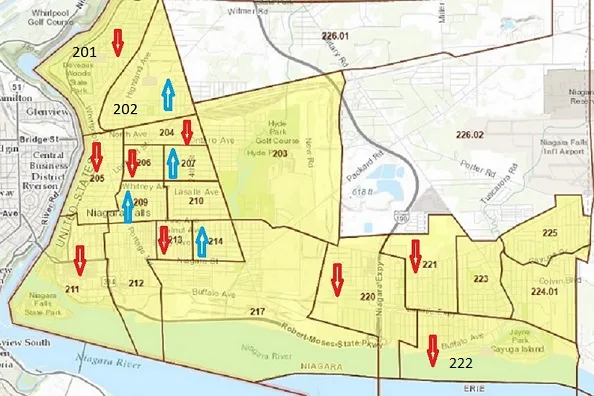
Drilling down on the newly-released census document, a couple of trends are conspicuous, including the fact that, of the nine census tracts that experienced significant population loss, five border the city’s waterfront.
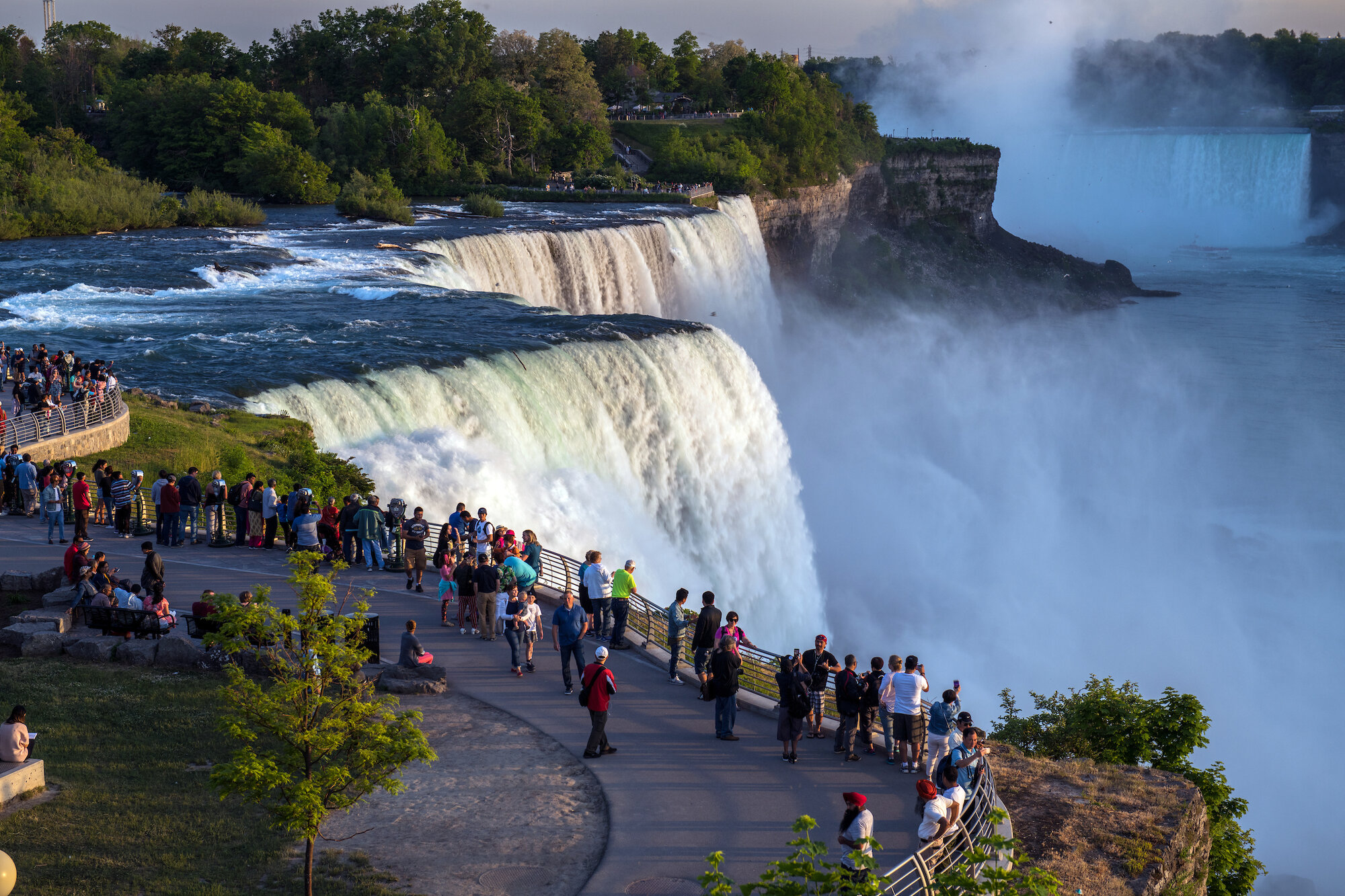
Actually, it isn’t the city’s waterfront, it belongs to the New York State Office of Parks, Recreation and Historic Preservation (“State Parks”). Since State Parks manages the waterfront solely for the exploitation of the eight million tourists who visit here every year, ensuring that their vacation dollars flow to Albany and Delaware North, it’s little wonder that the neighborhoods which essentially function as crossroads and thoroughfares for the millions who come and go from the state’s waterfront were predominantly the ones that experienced net population losses.
Remarkably, the vaunted Third Street tourism district, into which both the city and state have funneled many millions of development dollars over the years to little discernible effect, is the epicenter of one of the census tracts that have bled population since 2010.
And while the relatively affluent DeVeaux and Lasalle sections of the city comprised the major areas of population loss, the highest population gain in the city was by Census Tract 202, which envelopes Highland Avenue.
According to the 2016 American Community Survey, 1,700 of 2,657 of Highland Avenue’s Tract 202 residents, or 64.0%, lived below the poverty level.
In contrast, just 715 of 3,540 of DeVeaux’s Tract 201 residents, or 20.2%, lived below the poverty level, while only 330 of 3,725 of Lasalle’s Tract 222 residents, or 8.9%, lived below the poverty level.
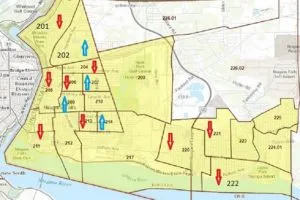
Over those years, from 2010 to 2016, DeVeaux’s population decreased by 243 and Lasalle by 159. The Highland Avenue area gained 463 residents over the same time span.
To sum up, when it comes to the city of Niagara Falls, the poor are moving in, and the rich are moving out, spurred on, no doubt, by the disproportionately high levels of crime, taxation and unemployment.
It was exactly ten years ago, on January 1, 2008, that Mayor Paul A. Dyster took his oath of office. Over those years, his policies have not only failed to address the root causes of endemic social misery here, but actually made it worse, in a city where a $619,000 work of “public art” and a new chicken wing restaurant are looked upon as signs of economic progress.