Jury Nullification set Wild Bill Hickok Free Although He Killed a Man Illegally!
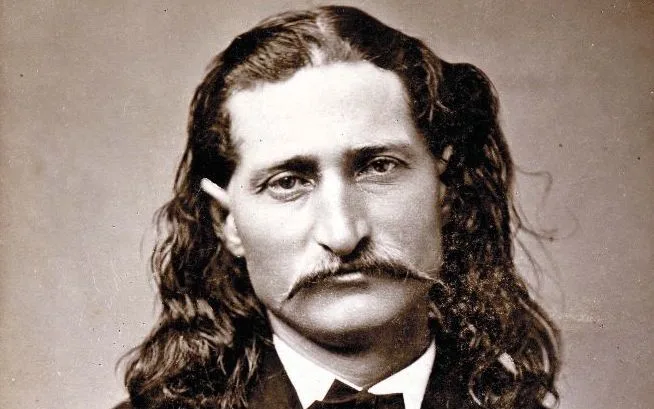
On July 20 1865, James Butler “Wild Bill” Hickok was playing in a poker game at the Lyon House Hotel in Springfield MO., when a friend of his, Davis Tutt showed up claiming Hickok owed him $45 from an earlier game.
Hickok said he only owed $25 since he had paid Tutt $20 some days before.
Tutt snatched Hickok’s Waltham Repeater gold pocket watch off the table and said he would keep it until Hickok paid the $45.
Hickok was livid, but outnumbered and outgunned, he quietly asked Tutt to put the watch back on the table.
Tutt left the premises with the watch.
Afterward Tutt’s supporters mocked Hickok, announcing they’d heard Tutt say he was planning to wear the watch “in the middle of the town square” the next day.
“He shouldn’t come across that square unless dead men can walk,” Hickok said.
The next day, Tutt arrived at the town square around 10 a.m. with Hickok’s watch openly hanging from his waist pocket. Hickok met Tutt at the square.
Tutt demanded $45. Hickok was adamant he owed $25.
Hickok said he would rather fight any man rather than Tutt for, as he said to him, “you have accommodated me more than any man in town for I have borrowed money from you time and again, and we have never had any dispute before in our settlement.”
Tutt said he didn’t want trouble either.
Then they went for a drink. Soon afterward Tutt left.
A few minutes before 6 p.m., Hickok was seen approaching the town square from the south, a .36 caliber Colt Navy in hand.
The townsmen came to witness.
Tutt came at six, with Hickok’s watch dangling from his waist pocket.
Across the square, Hickok stopped, faced Tutt, and called, “Dave, here I am.” He cocked his pistol, holstered it on his hip, and gave warning, “Don’t you come across here with that watch.”
Tutt stood with his hand on his pistol.
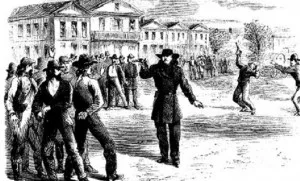
Both men faced each other sideways in the dueling position. Then Tutt reached for his pistol. Hickok drew his gun and steadied it on his opposite forearm. The two men fired. Tutt missed. Hickok’s bullet struck Tutt.
“Boys, I’m killed,” Tutt cried, and he ran to the porch of the courthouse and back to the street, where he collapsed and died.
The next day, a warrant was issued for Hickok’s arrest for murder.
Two days later he was arrested. The magistrate reduced the charge from murder to manslaughter.
Trial was set for August 3rd, his Hon. Judge Sempronius Hamilton Boyd presiding. The trial lasted three days. Twenty-two witnesses testified.
Hickok’s defense attorney was Col. John S. Phelps who had employed him during the Civil War. Hickok claimed self defense.
The prosecutor, R. W. Fyan, urged the jury to find Hickok guilty since Hickok’s claim of self-defense was invalid under state law which made “mutual combat” illegal. Fyan pointed out that Hickok came to the square armed and expecting to fight.
The jury, the prosecution said, had no choice but to find him guilty. He broke the law.
In what has become a famous instruction to the jury, Judge Boyd first told the jury that a conviction was its only option under the law of the State of Missouri.
“The defendant cannot set up justification that he acted in self-defense if he was willing to engage in a fight with deceased. To be entitled to acquittal on the ground of self-defense, he must have been anxious to avoid a conflict, and must have used all reasonable means to avoid it. If the deceased and defendant engaged in a fight or conflict willingly on the part of each, and the defendant killed the deceased, he is guilty of the offense charged, although the deceased may have fired the first shot.”
Then the judge instructed the jury that jurors always have the power, if they wish, whenever they wish it, to nullify the written law and, in this instance, apply the unwritten law of the “fair fight” and acquit.
After the jury deliberated for about an hour, the trial ended in acquittal on August 6.
The jury chose to nullify the written law prohibiting mutual combat.
Nothing better described the times than the fact that dangling a watch held as security for a poker debt was regarded as a justifiable provocation for resorting to firearms.
That a provoked man should be able to uphold his honor by dueling was, to the jury, more important than some effete law that prohibits two adult men from settling their affairs directly.
If, as it has been argued by some in the government, that the jury is only to judge the facts and not the law, the jury would have had to find Hickok guilty. He broke the written law.
But a jury, any jury, always has the power to nullify the law and find anyone “not guilty” of any “crime” if they, in their good conscience, do not believe the law is just, or properly applied. Even one juror can hang a jury. No one can coerce a single juror to vote with the majority of jurors. This is the cornerstone of our liberty.