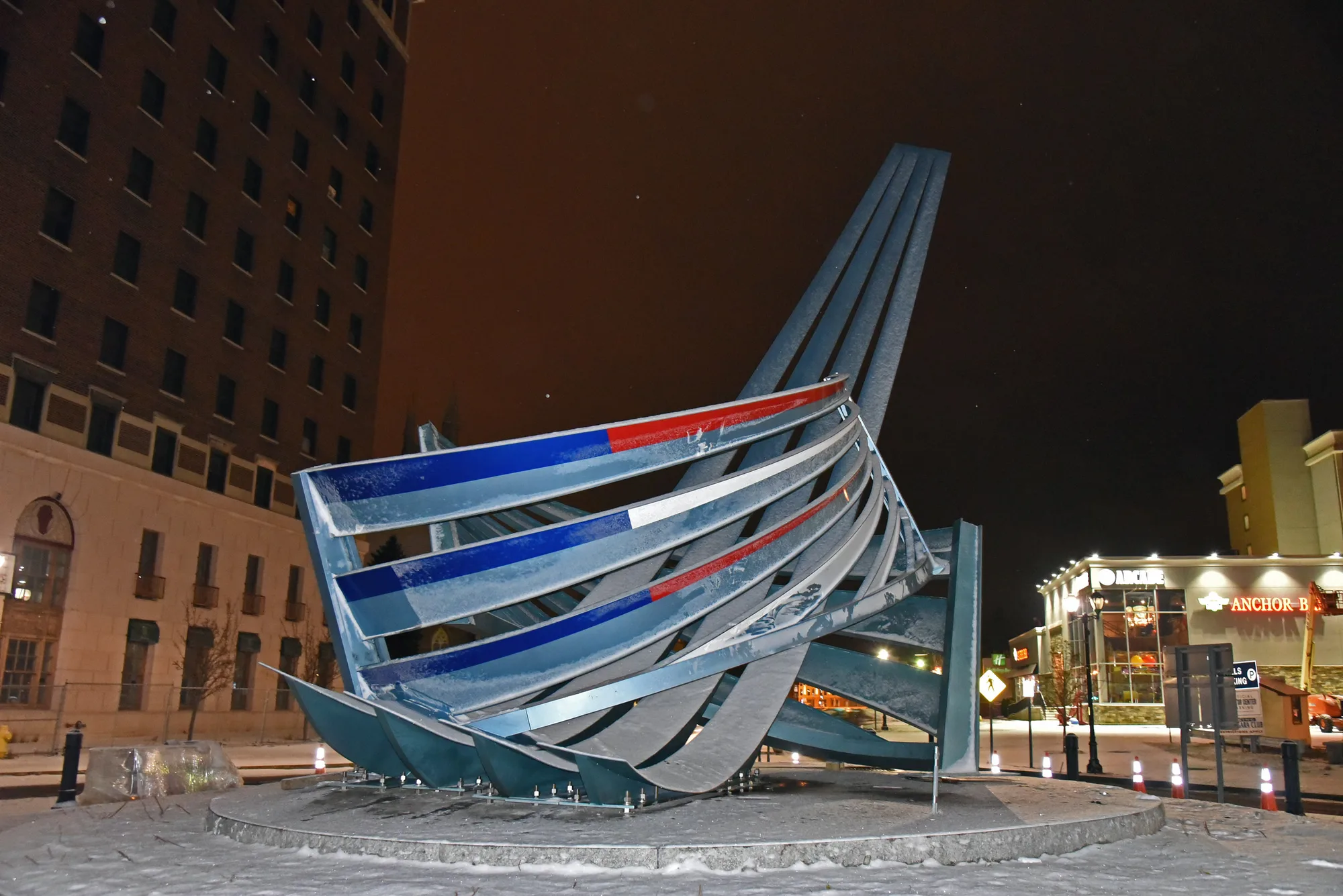
It’s been a rough debut for artist Jeff Laramore’s “Untroubled Waters” in downtown Niagara Falls‘ Centennial Circle.
Hundreds of residents have commented through social media on the $619,000 final price tag as well as the interpretive nature of the piece, which is to commemorate the obscure Boundary Waters Treaty of 1909 between the U.S. and Canada. (Mr. Laramore points out it could be the first environmental agreement. “Very significant,” he said.)
Comments include: It looks like a ski jump. Or the giant rib cage served to The Flintstones in their car. Donald Trump’s hair. A corporate logo. A handjob. It goes on and on and on…
Personally, it reminds me of another monumental “American” sculpture: the Marine Corps’ “Iwo Jima” memorial, with the mass of soldiers represented by the flag section, and the um, ski jump part being the stanchion.
The $650,000 “Untroubled Waters” has generated backlash from residents but only time will tell how history and tourists will judge it. Photo by Joseph Kissel.
What I find intriguing about the withering local criticism of the ginormous 33-foot by 33-foot sculpture is that it features an explicitly American theme (I’m not sure the bi-nationality aspect comes off) during a point in America’s history while the ruling national party is promoting American exceptionalism.
Making America Great Again. It’s easy to picture Mr. Trump standing on one of the swooshes while flashing a smile and a confident thumbs up.
Because how often does a significant piece of American-themed art appear? And in a location that is guaranteed to be seen by millions of people each year?
While it goes without saying residents’ reaction to the piece is tied into feelings for the mayor, the city’s impending financial doom and the price tag — which doubled in budget due to installation difficulties at the site regarding utilities — many of the people who see this will not be residents of this city or even this country.
Which begs the question: who is this beneficiary of this huge outlay of money on this public art installation? That said, it will be interesting to gauge tourists’ reactions and see how they interact with it, take photos with it and the like.
How it influences traffic in the busy circle during the summer months is also an unanswered question.
Mr. Laramore said he ultimately received no pay for designing and making the sculpture, with all of the budget going into the 254,000 pounds of concrete and 10,000 pounds of reinforced steel, and 3,100 man-hours going into fabricating the sculpture.
It’s composed of three separate steel structures and can be disassembled and moved, which was a stipulation from the administration, he said.
Only time will tell how city residents, critics of various stripes and the outside world responds to the currently ironically named “Untroubled Waters.”
By Tony Farina I’ve covered many court proceedings and trials in my more than 35 years as a newspaper and television reporter and I want to make the point at the beginning of this story that whether elected or appointed, some judges are fair and honest and many others fall short of the mark. In other words, the word jurist does not convey skill and knowledge of the law; it is just a role that some serve with distinction, and others do not. By definition, a jurist is a person who has expert or thorough knowledge of the law but
By Tony Farina There are certainly many questions swirling around the mayor’s declaration of a state of emergency in Niagara Falls over trash, blight, and deteriorating streets that was declared back on July 20 and has been extended several times since because, according to Mayor Robert Restaino, the City Council refused to approve contractor agreements. But some observers point to depleted staff at City Hall, like in Public Works and Code Enforcement and other departments, as really self-inflicted wounds that are the underlying reasons work is not getting done in the city. Or is there even more to the story,
The Data Center That Answers Hochul’s Objections There was a time when Niagara Falls did not ask Albany whether it was permitted to prosper. The river was here. That was enough. The town had something Albany couldn’t give it. It used what was here. Water. Power. Work. Jobs. Industry. A future. In 1895, the Adams plant took the river and put it into wire. The current went to Buffalo. It changed the industrial world. Tesla supplied the designs. Westinghouse built the machines. Niagara supplied the falling water. Then industries came. Electrochemical. Electrometallurgical. They came because Niagara offered abundant, inexpensive electricity.
By Tony Farina The City of Niagara Falls, N.Y., boasts one of the world’s greatest natural wonders that people from around the world come to see, but despite incredible tourism numbers of more than nine million visitors a year, the city of now less than 50,000 people is still pretty darn poor. Niagara Falls does not have a tourism problem; it has a tourism-capture problem, and the distinction should be a starting point for a serious new discussion about the city’s future. And ladies and gentlemen, that discussion needs to start now. The question is no longer whether Niagara Falls