Cuomo Lavishes $70 Million On Parkway, State Park Little Benefit Seen For Local Economy, Quality Of Life
by James Hufnagel
By the time the Niagara Falls State Park Landscape Improvements plan and south Robert Moses Parkway upgrade are finished sometime next year, Gov. Andrew Cuomo will have spent $70 million derived from Niagara Greenway, “Buffalo Billion” and “NY Works” economic development programs. That’s more than $140 for every man, woman and child living in the city of Niagara Falls. As the projects near completion, local residents are questioning whether anything much has really changed as the result of all that money being spent. What did we get out of it?
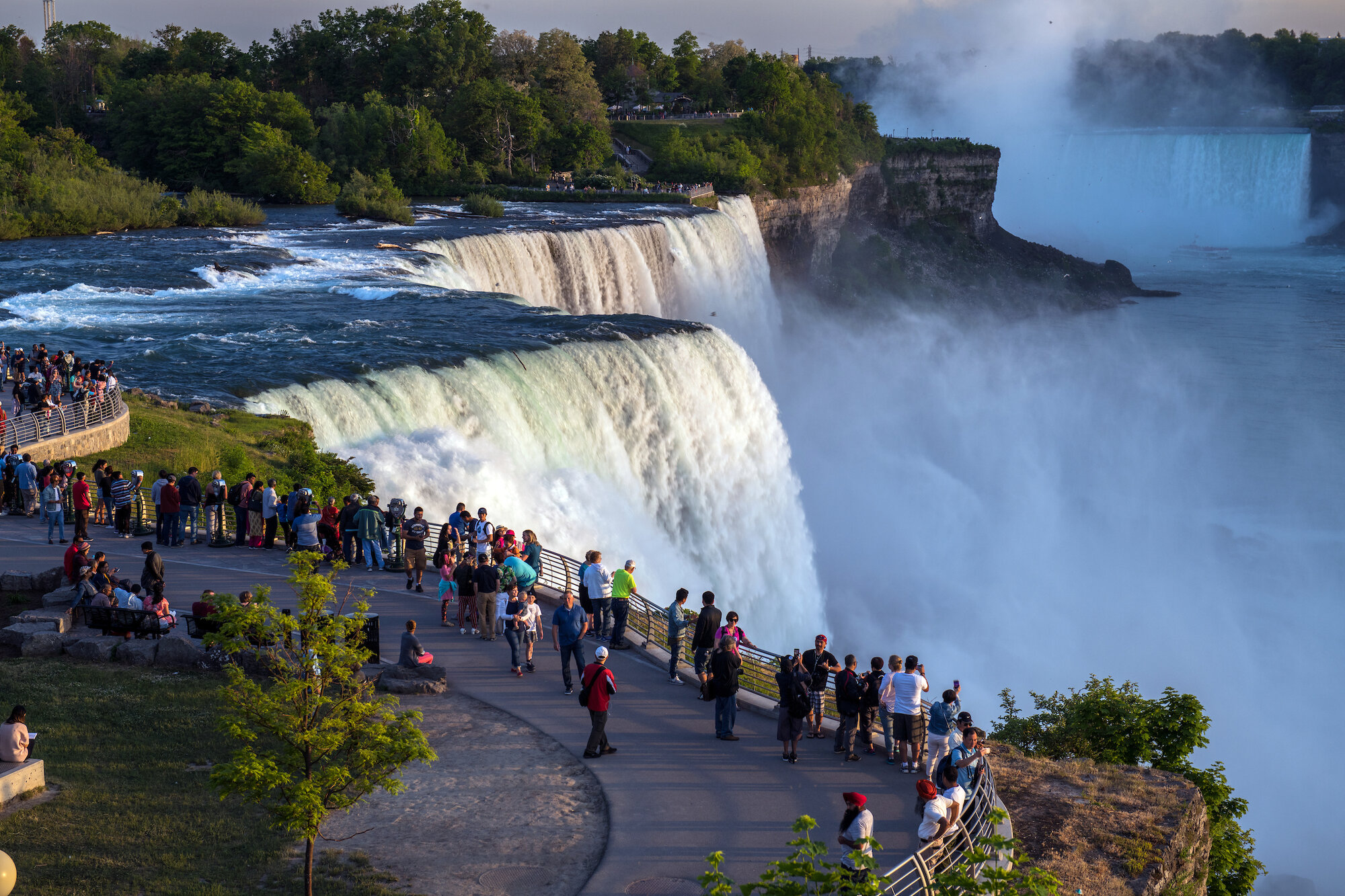
The oft-cited 2011 New York Times piece that infamously pronounced Niagara Falls State Park “shabby”, and that many believe provided the impetus for Cuomo’s extensive alterations to the 130-year-old former nature preserve, was written by Times travel columnist Barbara Ireland.
Comparing the tourist experience on both sides of the border, Ireland cryptically observed that, “in Niagara Falls, New York, the visitor who ventures inside the shabby, underfinanced state park is surprised to discover vestiges of something like a natural landscape.”
The article appeared three years after the 2008 start of the new Niagara Greenway, the first handful of grants from its projected 50-year, $450 million funding stream having just been awarded. In fact, by 2011, State Parks had already “banked” the greater share of its annual $3 million allotment. A solution looking for a problem, the Greenway windfall was burning a hole in the pocket of the local office of the staid State Parks agency when the Times travel article fortuitously surfaced.
Ireland is from Buffalo, and prior to joining the New York Times, wrote books and articles on travel and served on the editorial staff of the Buffalo News. You don’t have to be a conspiracy theorist to wonder if James Glynn, owner of the Maid of the Mist monopoly in Niagara Falls State Park, and Jeremy Jacobs, owner of Delaware North, which has the exclusive license to operate food, beverage and souvenir sales in the park, realized that tens of millions in government funding suddenly available to State Parks might somehow end up enhancing their bottom lines through “improvements” to the park, and utilizing close-knit local tourism connections, planted a story in the influential New York Times, the nation’s “newspaper of record”, to get the ball rolling.
Which brings us back to the main topic: How has spending $70 million on Niagara Falls State Park and the south Moses benefited the city? At the end of the day, what’s different?
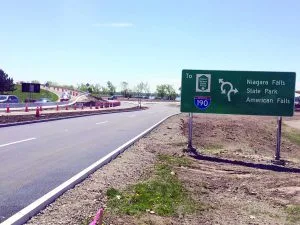
Despite an outpouring of public opposition against restoration of the south Robert Moses Parkway (“Public blasts Robert Moses Parkway Proposals for Redesign Project” as headlined in the April 28, 2009 issue of the Niagara Gazette), the New York State Office of Parks, Recreation and Historic Preservation, partnering with the state DOT, USA Niagara and Mayor Dyster, opted for a bigger, better south Moses Parkway, including new signage from the Grand Island Bridge west guiding visitors directly into Niagara Falls State Park. A new traffic roundabout, surrealistic in its splendid isolation on a barren landscape characterized by little more than an out-of-context stone chimney and assorted power authority infrastructure, has two exits – one to downtown and the other running along the river, blocking the city off from nearly a mile of scenic Niagara River rapids as it leads to the parking lots of Niagara Falls State Park.
Although the final Environmental Impact Statement for “Riverway” mentions crosswalks no fewer than eight times, supposedly to allow for public access across the newly-reconstructed parkway, only one seems to be in place, distant from downtown, connecting a particularly blighted section of Buffalo Avenue to an outlook near the power intakes. And since the speed limit at that location is 55 mph, you’d be well-advised not to try to exercise your pedestrian right-of-way when crossing on it.
How exactly did the $20 million Riverway “fully restore visual and physical access to the various natural and cultural features along the River,” as Gov. Cuomo contends in his press release?
What’s different is that a berm has been removed and a few trees planted next to a pointless traffic circle. What’s the same is that there remains a dedicated driveway into Albany’s Niagara Falls State Park, marring the river rapids, cutting the city off from its waterfront and giving motorists the option of bypassing the downtown business district altogether. Well played, Mayor Dyster.
Originally funded by Greenway to the tune of $25 million, Gov. Cuomo upped the price tag on his Niagara Falls State Park “Landscape Improvements” plan first to $40 million, then $50 million, funded by his NY Works initiative, which “is designed to reinvent state economic development with innovative new strategy that will put New Yorkers back to work rebuilding the state’s infrastructure,” according to an Albany press release.
Does $50 million spent on railings, fences, expanded parking lots, toll gates, bathrooms, a food pavilion and cutting down trees in the Niagara Falls State Park “enhance our environment, connect people to healthy, active outdoor recreation and energize local economies,” as Parks Commissioner Rose Harvey stated, or is Cuomo’s massive park makeover simply a mechanism for funneling untold millions to the numerous contractors who contribute to his campaign chest?