When the recently built $43 million train station provided lucrative employment for mostly out-of-city workers, residents from surrounding neighborhoods quickly noticed nobody from their community was employed at the site.
“It’s a hard process and the biggest problem we have is to change the culture,” said outgoing Council president Charles Walker after the city council voted recently to enforce citywide its collective bargaining agreement regarding local and minority hires.
“We have to go up against people who have been saying ‘we’ve been doing it like this for 35 years,'” he said.
“We need to change the whole issue of poverty in the Falls,” said Mr. Walker, followed by loud applause in the council chambers.
While some are skeptical of the impact mandated hiring will have on job sites, nearly everyone agrees something has to be done about the crushing poverty in Niagara Falls that drives crime and violence, as well the ongoing epidemic here of babies born addicted to drugs and other disturbing sociological trends.
It often falls on the Niagara Falls Police Department to deal with the day-to-day consequences of this spiraling situation, and at the final budget amendment meeting last week, the council OKed returning two detective positions to the budget.
In suggesting a different approach to police management, though, Councilman Andrew Touma also invoked the phrase “changing the culture.”
He asked Police Superintendent Bryan DalPorto if it was feasible to return to a schedule of five days on and two days off instead of the current four and two that was adopted in 1985.
“It’s something the police department would have to accept,” Mr. DalPorto said, referring to the union’s contract.
Mr. Touma said he would not be surprised if most residents did not know police officers worked eight hour shifts.
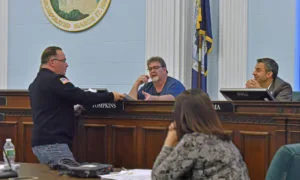
Happier Times? Police Chief DalPorto (left) and Councilman Andrew Touma (right) appear to be on opposite sides on the budget battle over cuts to the police department.
Another resident suggested during the winter months — when he said anecdotally criminal activity seems to wane — as a money-saving effort, police could adopt an on-call system instead of a fixed amount of officers on the streets.
Having police living within the city would aid in this plan.
Although the resident didn’t say it, this would amount to more “changing the culture,” and one wonders how many times this phrase will be invoked as the city charts a new course and undertakes the corrective measures necessary for it not only to survive but thrive.
In other news… the Discover Niagara Shuttle will receive $70,000 in funding from the county approved unanimously by the legislature. The body is working on a permanent solution for funding with the state and the county, according to Legislator Jay Zona. NYPA also contributes $300,000, and he said if the shuttle starts charging a fee the authority would pull the money. He said no explanation was given as to why that would happen.
Despite the fact that the “free” Discover Niagara shuttles drive around the county practically devoid of passengers, like ghost ships with no purpose other than costing taxpayers and ratepayers $1 million a year, the politicians are falling over each other to continue funding the expensive, and failing, experiment.
By Tony Farina I’ve covered many court proceedings and trials in my more than 35 years as a newspaper and television reporter and I want to make the point at the beginning of this story that whether elected or appointed, some judges are fair and honest and many others fall short of the mark. In other words, the word jurist does not convey skill and knowledge of the law; it is just a role that some serve with distinction, and others do not. By definition, a jurist is a person who has expert or thorough knowledge of the law but
By Tony Farina There are certainly many questions swirling around the mayor’s declaration of a state of emergency in Niagara Falls over trash, blight, and deteriorating streets that was declared back on July 20 and has been extended several times since because, according to Mayor Robert Restaino, the City Council refused to approve contractor agreements. But some observers point to depleted staff at City Hall, like in Public Works and Code Enforcement and other departments, as really self-inflicted wounds that are the underlying reasons work is not getting done in the city. Or is there even more to the story,
The Data Center That Answers Hochul’s Objections There was a time when Niagara Falls did not ask Albany whether it was permitted to prosper. The river was here. That was enough. The town had something Albany couldn’t give it. It used what was here. Water. Power. Work. Jobs. Industry. A future. In 1895, the Adams plant took the river and put it into wire. The current went to Buffalo. It changed the industrial world. Tesla supplied the designs. Westinghouse built the machines. Niagara supplied the falling water. Then industries came. Electrochemical. Electrometallurgical. They came because Niagara offered abundant, inexpensive electricity.
By Tony Farina The City of Niagara Falls, N.Y., boasts one of the world’s greatest natural wonders that people from around the world come to see, but despite incredible tourism numbers of more than nine million visitors a year, the city of now less than 50,000 people is still pretty darn poor. Niagara Falls does not have a tourism problem; it has a tourism-capture problem, and the distinction should be a starting point for a serious new discussion about the city’s future. And ladies and gentlemen, that discussion needs to start now. The question is no longer whether Niagara Falls